 Nephrology
 Urology
 Andrology
 Fertility (IVF)
 General Nephrology
 Paediatric Nephrology
 Dialysis
 Renal (Kidney) Biopsy
 CRRT
 Peritonial Dialysis
 Robotic Surgery
 Urinary Incontinence
 Uro-Oncology
 Laparoscopic Urology
 Reconstructive Urology
 Anaesthesiology
 Radiodiagnosis
 Nutrition and Dietetics
 Pediatric and Immunization
 Cardiology
 Intensive Care Unit




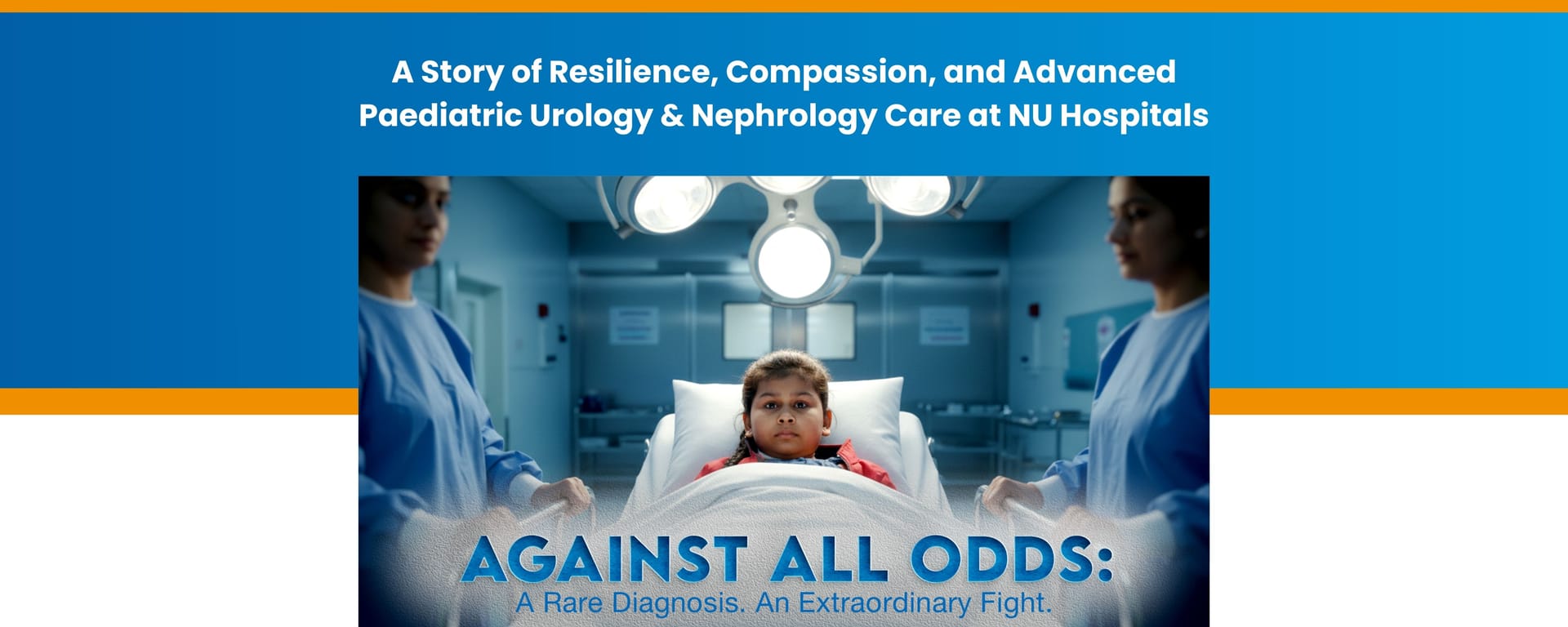
This is Divya's (Pseudonym) story, a story of resilience, rare illness, and the care she received at NU Hospitals.
An Assistant Professor of Economics talks about his daughter, Divya and the pain she has endured since childhood.
Divya was just seven years old when her family’s life changed forever.
“She was diagnosed with diabetes when she was only seven,” her father recalls. “From that day, we started giving her insulin four times a day.”
Managing childhood diabetes itself was overwhelming. Blood sugar monitoring, insulin injections, and dietary adjustments became part of everyday life.
But soon, there were other complications.
From the age of seven or eight, Divya began complaining of stomach pain. She also developed frequent urination. During family trips, her father had to stop the vehicle repeatedly.
“Even while travelling, she needed to urinate frequently. It became very difficult,” he says.
Local doctors were consulted, and scans were done. Divya was diagnosed with a bladder condition. Her treatment began, however the symptoms did not improve fully. Recurrent urinary infections continued.
Our family knew something else was wrong.
In 2007, we consulted a doctor in Davanagere for her ongoing urinary infections and frequent urination. He mentioned, “Since she has repeated urinary infections and frequent urination, you must take her to NU Hospitals, Bangalore.”
We finally decided to take that leap of faith and visit NU Hospitals, Bangalore.
At NU Hospitals, specialists from the Departments of Paediatric Urology and Paediatric Nephrology evaluated Divya. The assessment was detailed, and a diagnosis was given.
Divya was diagnosed with a rare genetic condition called DIDMOAD Syndrome along with detrusor underactivity. Her urinary bladder had become flaccid. It is also known as Wolfram Syndrome.
DIDMOAD stands for:
-
D – Diabetes Mellitus
-
I – Insipidus
-
D – Diabetes Mellitus
-
M – Optic Atrophy
-
O – Optic Atrophy
-
A – Acoustic deafness
-
D – Deafness
It is a rare neurodegenerative disorder. Therefore, it explained her other symptoms.
Over time, prolonged diabetes had caused further complications. Divya had also developed:
-
Due to detrusor underactivity, her urinary bladder was not contracting properly, and
-
Renal dysfunction, her kidney function was affected
From then on, her treatment began at NU Hospitals. For the past two to three years, her family has been visiting NU Hospitals every few months for follow-up and monitoring. The continuity of care helped closely track her kidney function and overall health.
During one such routine visit, a concerning development was found.
“One day during a routine check-up, she felt extremely fatigued,” her father remembers. “We later found that her creatinine levels had spiked.”
It was a serious moment.
Our team at NU Hospitals first inserted a urethral Foley catheter to drain her bladder continuously. This helped reduce the pressure on her kidneys. Over the next month, her creatinine levels gradually normalised.
But the bigger question remained: What to do next?
In most children with bladder dysfunction, our team at NU Hospitals teaches the child how to use Clean Intermittent Catheterisation (CIC). The child learns to empty the bladder every 3–4 hours by inserting a catheter.
But Divya was both blind and deaf due to her underlying syndrome; therefore, this option was ruled out.
Keeping a permanent catheter long-term was also not safe.
The team had to think differently.
Then we decided to do an Ileal Conduit Urinary Diversion, a complex procedure.
-
We connected her ureters to a small segment of her intestine, bringing that segment out through the abdominal wall
-
A bag was then attached externally to collect her urine.
-
The caregiver can empty her bag at regular intervals.
This would protect her kidneys and offer a safer long-term solution.
It was not an easy decision. But it was the best choice to improve the quality of life.
While most patients recover within a few days after such surgery, Divya’s journey was quite different.
Her sodium levels shot up, reaching 162. Due to this, she also had a stormy postoperative period. She also developed protracted ileus; her intestines temporarily stopped functioning. She could not be fed for almost two weeks. She was shifted to the ICU.
For more than two weeks, she remained under intensive care. She was supported with parenteral nutrition.
Our team at NU Hospitals did not give up, and neither did Divya.
Her sodium level was monitored carefully. Every complication was addressed immediately.
Slowly, steadily, she improved.
After three weeks in the hospital, including more than two weeks in the ICU, she was discharged home.
Today, Divya is stable. Her kidney function has recovered, and her urinary diversion is functioning well.
Her family continues with regular follow-ups at NU Hospitals every few months.
“Now my daughter is completely fine,” her father says with visible relief.
“I am happy that we have such a well-renowned hospital in Bangalore. If there weren’t such a hospital here, we wouldn’t have known where to go.”
“This is a true testament to multi-disciplinary care. With coordinated efforts from paediatric urology, paediatric nephrology, paediatric anaesthesia, ICU, dietetics, and excellent nursing support, we were able to make a real difference in her quality of life.”
Divya's journey is a reminder that rare conditions demand rare courage from patients, parents, and doctors.
Her father never stopped searching for answers. Her doctors at NU Hospitals never stopped working toward a solution. And Divya never stopped fighting.
At NU Hospitals, her case was not just another file; she was treated like an individual.
Today, because of that care, Divya's life continues with stability and dignity.
If you are a parent and your child is dealing with a complex paediatric urology or paediatric nephrology medical condition, visit NU Hospitals for answers and hope.
Early intervention and the right team can change the future for your family.
Reference Video:








