 Nephrology
 Urology
 Andrology
 Fertility (IVF)
 General Nephrology
 Paediatric Nephrology
 Dialysis
 Renal (Kidney) Biopsy
 CRRT
 Peritonial Dialysis
 Robotic Surgery
 Urinary Incontinence
 Uro-Oncology
 Laparoscopic Urology
 Reconstructive Urology
 Anaesthesiology
 Radiodiagnosis
 Nutrition and Dietetics
 Pediatric and Immunization
 Cardiology
 Intensive Care Unit




Introduction
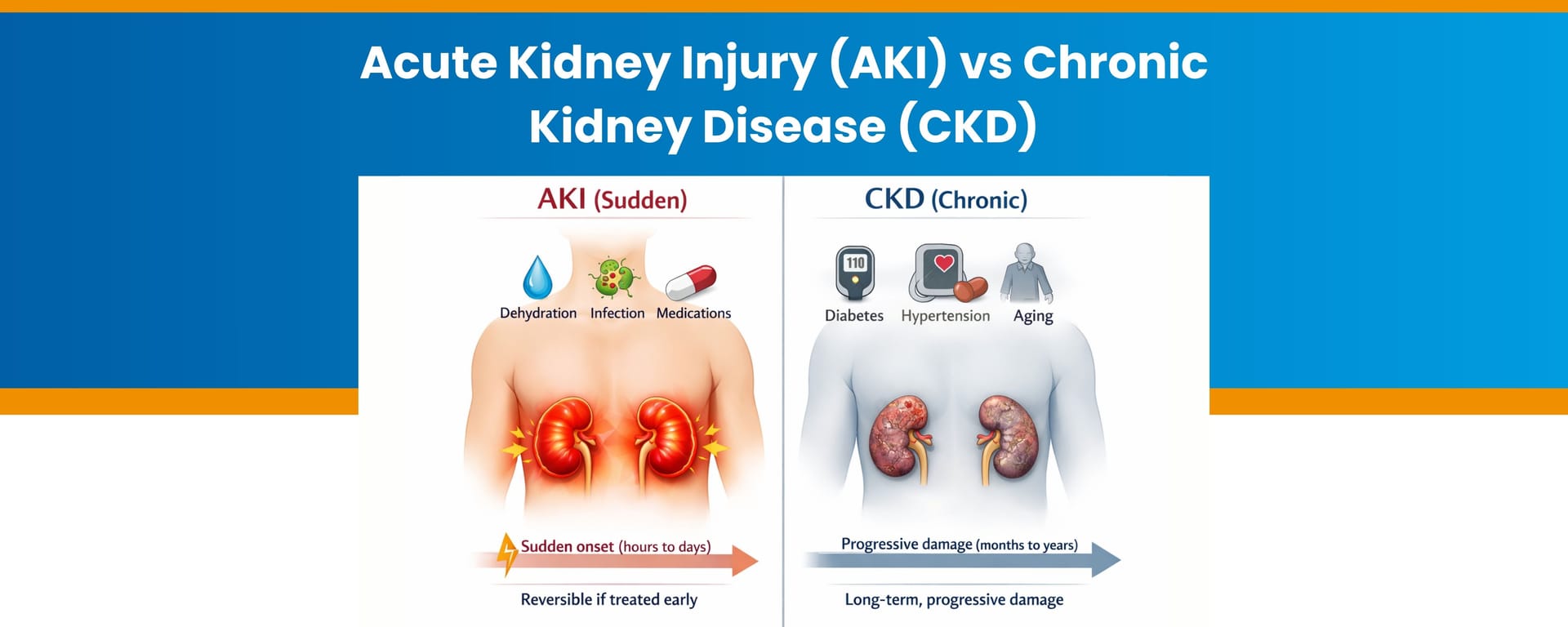
Kidney dysfunction is not a disease but a spectrum of disorders. The most important difference between acute kidney injury (AKI) and CKD lies in their timing, reversibility, and long-term consequences. Even though both disorders involve the kidneys and lead to an increase in serum creatinine levels, the underlying causes, progression, and management of both disorders are entirely different.
It is important to note the difference between the two disorders because, in AKI, if prompt action is taken, then the kidney damage can be reversed; however, in CKD, patients are having irreversible damage to the kidney.
What is Acute Kidney Injury (AKI)?
Acute Kidney Injury can be defined as the sudden onset of kidney function loss that happens in a few hours to a few days. This leads to a sudden accumulation of waste products in the blood and electrolyte disturbances.
AKI can be caused by the following:
-
Severe dehydration
-
Sepsis or systemic infections
-
Surgery
-
Nephrotoxic drugs (NSAIDs, antibiotics, and contrast agents)
-
Prerenal azotemia due to reduced blood flow
-
Acute Tubular Necrosis (ATN)
The symptoms of AKI may include the following:
-
Oliguria (reduced urine output)
-
Swelling of the legs and/or face
-
Confusion due to uremic encephalopathy
-
Sudden elevation of serum creatinine levels
The key thing to remember about AKI is that it is potentially reversible.
What is Chronic Kidney Disease (CKD)?
Chronic Kidney Disease is marked by kidney damage or a reduced glomerular filtration rate (eGFR) that lasts for more than 3 months. Unlike AKI, CKD is generally irreversible, although progression can be slowed or stabilized with appropriate treatment.
The causes of CKD are:
-
Diabetes
-
Hypertension
-
Glomerulonephritis
-
Polycystic kidney disease
-
Kidney infections
CKD is often symptomless in its early stages. Patients may not develop symptoms until the kidney function is reduced to half.
Pathophysiological Differences
In AKI, the injury is typically functional or structural but recent. The kidneys appear normal in size and can return to normal once the underlying issue is resolved.
In CKD, progressive nephron injury leads to scarring, a decrease in kidney size, in some cases, an altered architecture of the kidney and a permanent reduction in eGFR. Chronic inflammation and fibrosis are the characteristic findings.
The serum creatinine concentrations also have a different time course:
-
In AKI: Sudden rise over hours to days
-
In CKD: Gradual rise over months to years
This allows the physician to distinguish between acute and chronic disease.
AKI vs CKD: Clinical Differentiators
AKI vs CKD Comparison Table
Parameter |
Acute Kidney Injury |
Chronic Kidney Disease |
Onset |
Sudden |
Gradual |
Duration |
Less than 3 months |
More than 3 months |
Urine output |
Often reduced |
May be normal initially |
Ultrasound |
Normal kidney size |
Varying size and echotexture |
Anemia |
Rare early |
Common in later stages |
Reversibility |
Often reversible |
Usually irreversible |
KDIGO AKI Staging Criteria
Accurate staging helps determine severity and guide treatment.
KDIGO AKI Staging Table
Stage |
Serum Creatinine Increase |
Urine Output Criteria |
Stage 1 |
1.5 to 1.9 (baseline) |
Less than 0.5ml/kg/hr (6 to 12 hours) |
Stage 2 |
2.0 to 2.9 (baseline) |
Less than 0.5 ml/kg/hr (more than 12 hours) |
Stage 3 |
More than 3 (baseline), dialysis is required |
Less than 0.3 ml/kg/hr (more than 24 hours) |
Prompt recognition at Stage 1 itself significantly improves overall outcomes.
Acute on Chronic Kidney Disease
Patients with underlying CKD may develop an acute insult, such as infection or dehydration. This condition is known as acute-on-chronic kidney disease.
This condition needs urgent care because:
-
The underlying reserve of the kidneys is already compromised
-
The potential for recovery is limited
-
The chances of becoming dialysis-dependent are increased
Careful differentiation between the two conditions is necessary based on past medical history and ultrasound.
Renal Recovery Signs After AKI
The extent and time course of recovery from AKI are also significant.
The following are the positive signs of recovery from AKI:
-
Increase in urine output
-
Decrease in serum creatinine levels
-
Stabilisation of electrolytes
-
Improvement in eGFR
However, it has been noticed that patients are at risk of developing CKD even after recovery from AKI.
Treatment Approach: Why Early Differentiation Matters
Differentiation at an earlier stage is crucial for making informed choices and better decisions. Both conditions, AKI and CKD, differ and require different treatments. Differentiation thus becomes crucial to enhance the treatment outcomes and further choose the right treatment option for the individual’s health condition. Let’s take a look at the management of both conditions one by one.
Management of AKI
Treatment for AKI usually focuses more on:
-
Correcting dehydration
-
Treating infections promptly
-
Stopping nephrotoxic medications
-
Hemodynamic stabilization
-
Dialysis in severe cases
Many patients recover fully if the condition is managed on time and early medical intervention is sought.
Management of CKD
Treatment for CKD mainly aims to:
-
Control the blood pressure levels and diabetes
-
Slowing the progression of kidney dysfunction rate
-
Manage complications like anaemia and bone disease
-
Prepare for dialysis or transplant if needed.
The therapeutic goal in CKD is preservation and not reversal. This is primarily because reversal is not feasible in all cases, and the focus should be on preserving kidney function to improve the patient's quality of life.
NU Hospitals Critical Care Nephrology
At NU Hospitals, early differentiation between AKI and CKD is prioritised with the help of the following measures:
-
Bedside ultrasonography for kidney size assessment with minimal discomfort
-
Efficient serum creatinine kinetics monitoring
-
Advanced lab profiling for comprehensive reports
-
Renal Replacement Therapy in Critically Ill Patients
-
Early hemodynamic optimization in ICU settings
The integrated nephrology and critical care team ensures that evidence-based medical intervention is provided to the patient to maximize renal recovery and prevent long-term benefits in cases of acute kidney injuries like AKI and CKD.
Conclusion
The main points of distinction between Acute Kidney Injury (AKI) and Chronic Kidney Disease (CKD) are reversibility and duration. AKI is a sudden onset of kidney failure, which is usually reversible in nature, and CKD, on the other hand, is a progressive, irreversible kidney failure that lasts for more than three months. Early diagnosis and treatment at NU Hospitals, using ultrasound, creatinine kinetics, and critical care principles and healthcare measures, can prevent the rapid progression of kidney injury to chronic kidney disease. Timely attention from an expert significantly optimizes the procedure outcomes for patients.