 Nephrology
 Urology
 Andrology
 Fertility (IVF)
 General Nephrology
 Paediatric Nephrology
 Dialysis
 Renal (Kidney) Biopsy
 CRRT
 Peritonial Dialysis
 Robotic Surgery
 Urinary Incontinence
 Uro-Oncology
 Laparoscopic Urology
 Reconstructive Urology
 Anaesthesiology
 Radiodiagnosis
 Nutrition and Dietetics
 Pediatric and Immunization
 Cardiology
 Intensive Care Unit





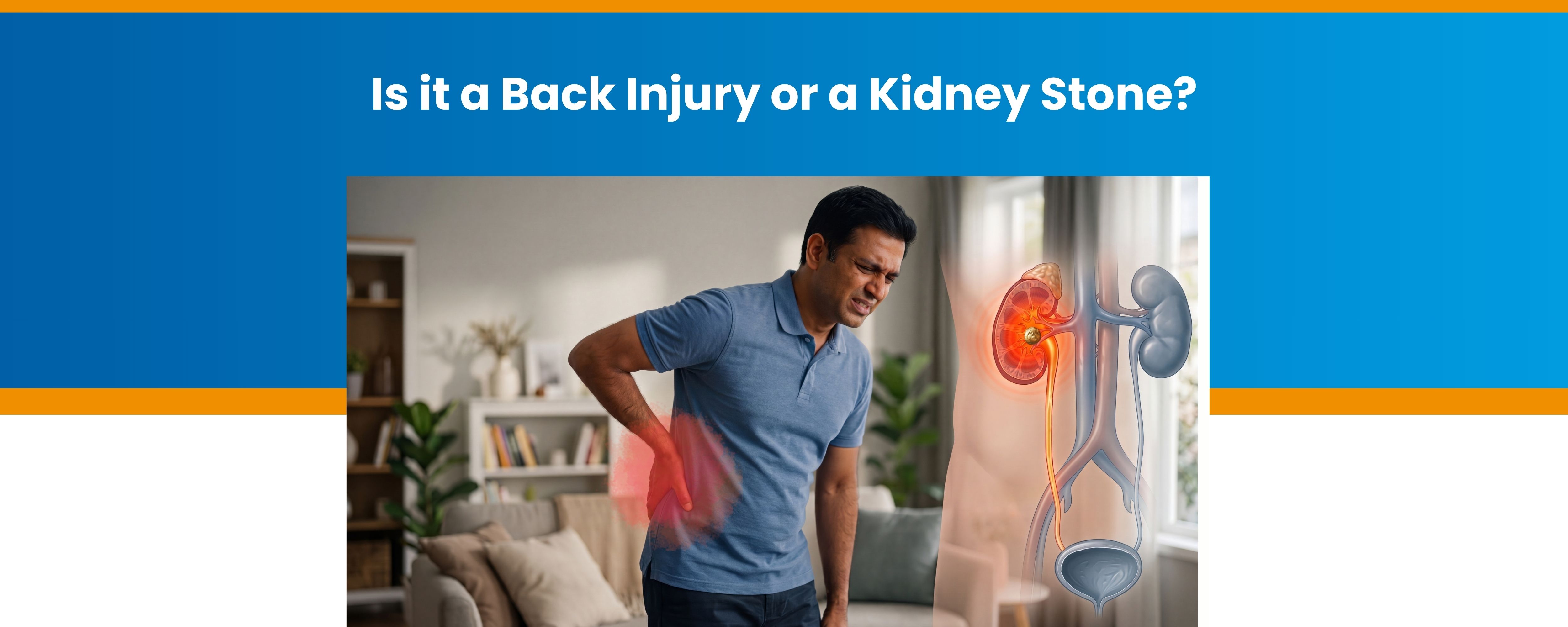
Waking up with a sharp pain in your lower back can be concerning, especially if it’s sudden and you cannot figure out the root cause. You could have slept wrong, injured your back, or pulled the wrong muscle during a workout. However, it could also mean something much more. The lower back isn’t just the architecture of the spine and muscles, but also the kidneys. People may try to “treat” the pain through heat packs and stretches, only to find out later that the source of their agony was a tiny stone blocking the urinary tract. Understanding the difference between kidney stone vs back pain is crucial for effective treatment.
Quick Overview
People can mistakenly assume that the sudden onset of a kidney stone is a simple back strain; however, the clinical characteristics of the two are fundamentally different. Identifying whether you are experiencing musculoskeletal back pain vs kidney pain is crucial for correct intervention.
While musculoskeletal back pain is dull, localised, and worsens with movement, a kidney stone causes sharp, spasmodic pain, occurring in intense waves. Also known as renal colic, it is characterised by nausea, vomiting, blood in the urine, or frequent urination. This means that the pain you are witnessing is of renal origin and would require immediate medical attention.
Causes of Kidney Pain and Back Pain
Backaches or flank pain are common. There are a lot of flank pain causes, but how does one differentiate between musculoskeletal back pain vs kidney pain? Let’s take a look.
Kidney pain’s primary reasons include:
- Kidney stones
- Urinary Tract Infection
- Blood clotting
- Infections
- Injury to the organ
On the other hand, musculoskeletal back pain may be caused by:
- Bad posture
- Stress and strain on muscles
- Standing or sitting in the same position for a prolonged time
- Injuries
- Spine tumors
- Abnormal curvature of the spine
- Intervertebral disc prolapse (herniated disc)
Why do these pains feel similar, though? Well, the answer lies in the concept of referred pain, since the nerves supplying the kidneys and the muscles of the lower back come from similar levels of the spinal cord.
How to Tell if Back Pain is Kidney Related?
If you are wondering how to tell whether back pain is kidney-related, look for systemic red flags in your symptoms. When the discomfort in your back is accompanied by nausea, vomiting, a persistent urge to urinate, or hematuria, which is the presence of blood in your urine, there is a chance that the pain is not musculoskeletal, but may be renal colic.
Symptoms of Renal Colic
In simple terms, renal colic is an intense flank pain in the kidney region caused by obstruction of urine flow from your kidney to your bladder. Waves of renal colic can come in waves and last anywhere between 20 and 60 minutes. Symptoms of renal colic include:
- Nausea and vomiting
- Dysuria: Pain while peeing
- Hematuria: Blood in pee
- Cloudy or smelly pee
- Change in the frequency of urination; either less or more
- Fever and/or chills
As the stone moves, the pain follows a specific pain radiation pathway:
Stone Location |
Primary Pain Site |
Radiation Pattern |
Kidney |
Upper flank/side |
Deep ache underneath the ribs. |
Upper Ureter |
Mid-flank/side |
Pain wraps around toward the navel. |
Lower Ureter |
Lower abdomen |
Radiates sharply towards the groin/inner thigh. |
Bladder Junction |
Pelvic region |
Intense pressure, urgency, spasmodic pain. |
In case of kidney stones, you may feel the pain begin in the side or back, just below the ribs. As the stone moves, the pain can travel to other regions, such as the lower abdomen, groin, or sometimes even the inner thigh.
More often than not, a kidney stone can be passed from the comfort of your home, especially if it is small in size. In order to do so, make sure you are staying hydrated and managing the pain with the help of medication prescribed by your doctor.
Role of Costovertebral Angle Tenderness (CVAT)
Costovertebral Angle Tenderness often indicates kidney pathology and is performed as part of the abdominal exam. The CVA is the internal angle formed by the 12th rib and the spine. A physician will gently tap this area to figure out the root cause of the pain. If the cause is musculoskeletal, the person may feel a dull thump after the tap. However, if it’s kidney-related, a light tap, too, will cause them significant pain.
How to Know if the Pain is Due to a Kidney Infection?
Apart from a kidney stone, the pain may also be due to a kidney infection. The symptoms may include high fever, chills, a sense of malaise, and, yes, back pain. This is a medical emergency, and you would need to talk to your doctor at the earliest.
What is Radiculopathy?
Again, while the pain may feel similar, the cause may not be kidney-related at all. In fact, radiculopathy is a musculoskeletal disorder that results from structural changes and compresses, inflames, and injures spinal nerve roots. There are two types of radiculopathies: lumbar and cervical.
Lumbar radiculopathy affects the lower back or legs, while cervical radiculopathy affects the neck and arms. Symptoms may include sharp, radiating, or burning pain, numbness, tingling, and muscle weakness.
Feature |
Muscle Strain/Back Injury |
Kidney Stone (Renal Colic) |
Onset |
Often sudden, after a specific activity or injury. |
Usually sudden and spontaneous. Can occur even while at rest. |
Movement |
Pain worsens with movement, bending, or twisting. |
Movement does not affect the pain. |
Radiation |
Stays in the back or moves lower to the legs. |
Moves from flank to the groin or labia/testicles. |
Urinary Symptoms |
None. |
Hematuria, urgency, and burning sensation. |
Relief |
Improves with rest or posture changes. |
Pain persists despite changes in posture. Consult a doctor. |
Exercises for Back Pain vs Kidney Pain
If the cause of the pain is musculoskeletal, stretching and yoga may help provide relief. You can try out the Cat-Cow or Child’s Pose for relief. However, if the pain is caused due to a stone, exercises won’t help and may even cause more discomfort.
How NU Hospitals Can Help
We at NU Hospitals believe in the Rapid Stone Triage program, which uses a clinical pathway to provide our patients with immediate clarity and the answers they need. It helps us and our patients to eliminate the ambiguity that comes with figuring out musculoskeletal back pain vs kidney pain.
Patients undergo CVA Tenderness testing and the physical assessment allows our team of highly skilled medical professionals to differentiate renal pain from muscular or spinal pain, preventing delays in treatment that may prove to be dangerous.







