 Nephrology
 Urology
 Andrology
 Fertility (IVF)
 General Nephrology
 Paediatric Nephrology
 Dialysis
 Renal (Kidney) Biopsy
 CRRT
 Peritonial Dialysis
 Robotic Surgery
 Urinary Incontinence
 Uro-Oncology
 Laparoscopic Urology
 Reconstructive Urology
 Anaesthesiology
 Radiodiagnosis
 Nutrition and Dietetics
 Pediatric and Immunization
 Cardiology
 Intensive Care Unit




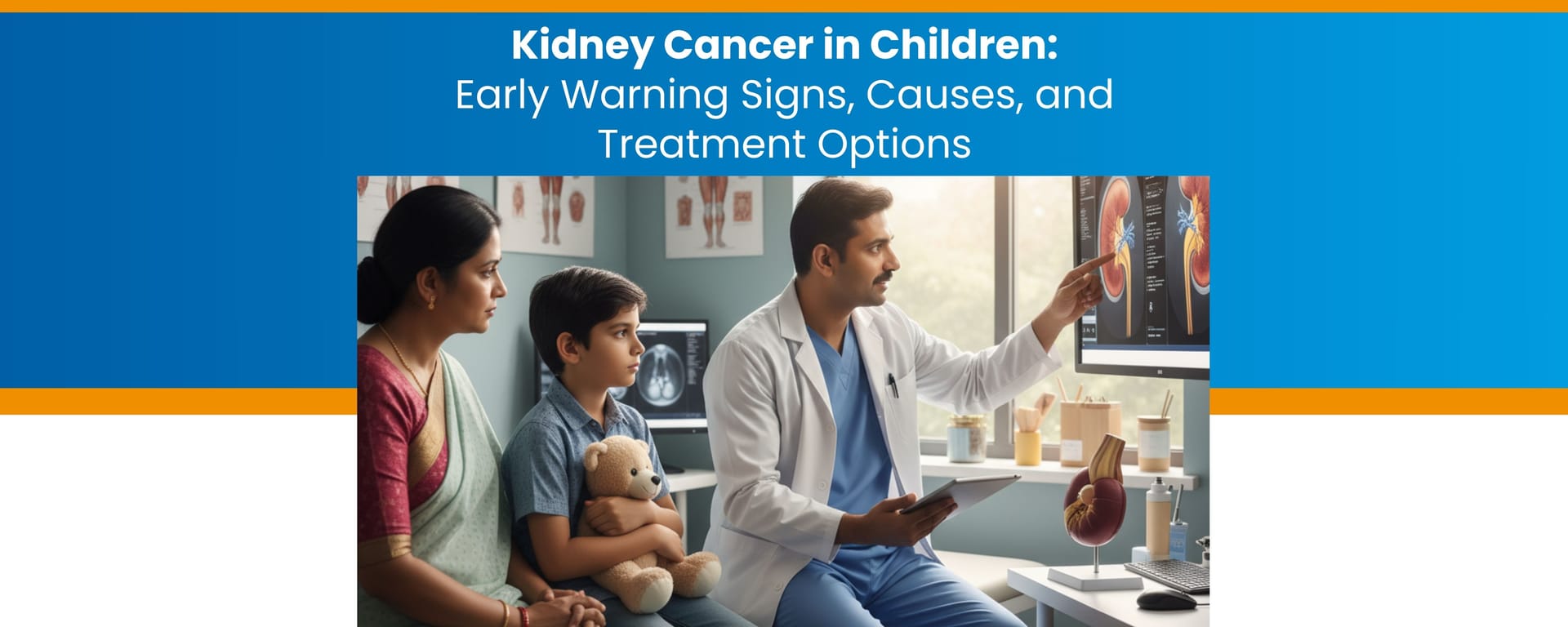
Kidney cancer is very rare in children. It is one of the least occurring abdominal cancers in children, and it represents about 6-7% of cancers in children under the age of 5, around the world. Though it is rare in occurrence, it is a serious condition.
This is definitely a concern to be addressed at the earliest. The thought of imagining your child with such a disease is a pain in itself.
But be assured, they can be brought back to a normal lifestyle and have a recovery if treated early.
What if we told you what symptoms to look out for, when to consult with an expert, and the right treatment can treat your child better?
Hearing about kidney cancer in children can feel very overwhelming, but knowing how to deal with it will help you gain confidence.
This blog will help you understand different types of kidney cancer in children, their causes and advanced treatment options.
What Is Kidney Cancer in Children?
When your child’s kidneys (one or both) have an abnormal cell growth inside the kidney, it is known as kidney cancer. The growth of cancer cells is very aggressive and uncontrollable, leading to tumour formation.
Whenever we think of cancer, we only think about adults, but it can develop in children, too. As you know, kidneys are the filters of the body, and when there is cancer development, it jeopardises the kidney function.
If not treated on time, the abnormal cell growth can sometimes spread to other parts of the body.
The good news is that with early detection and expert care from our specialists, your child can live a healthy life.
Types of Kidney Cancer in Children
Wilms’ tumour is a common type of kidney cancer in children. It is called nephroblastoma, affecting children below 5 years of age,
There are other less common types of kidney cancer as well; here is a list of some major kidney cancers in children.
Wilms’ Tumour
Wilms’ Tumour is the most common type of kidney cancer in children. Out of 10 paediatric kidney cancer cases, nearly 9 are Wilms’ tumour.
This develops when the kidney cells fail to mature during fetal development. These immature kidney cells multiply and grow uncontrollably, creating a tumour in the kidney.
This tumour is a mixed structure which contains different cell types like blastemal (primitive cells), stromal (connective tissue), and epithelial cells (lining of kidney tubules)
It is highly treatable and offers high survival rates when detected early.
Clear Cell Sarcoma of the Kidney (CCSK)
This is a rare form of kidney disease in children, CCSk spreads more often to the bones, brain and even lungs. This is seen in younger children and rarely in older kids.
Clear cell sarcoma of the kidney develops from the mesenchymal cells, the connective tissue cells.
They have a distinctive appearance under the microscope due to the way they store lipids and glycogen in the cytoplasm. CCSK infiltrates the surrounding tissues and blood vessels, which increases the speed to bones and other organs
It can be managed and treated effectively with different treatment options
Rhabdoid Tumour of the Kidney
Often occurring in babies and toddlers under 2 years of age, rhabdoid tumours are very rare and aggressive in nature. They can grow fast and spread to other parts of the body.
This is caused by gene mutations of the kidney cells (SMARCB1/INI1 gene). This gene is responsible for regulating cell growth.
When this gene is not active, there is no control on cell growth, causing tumours.
This kidney cancer grows rapidly and spreads beyond the kidneys very soon.
Renal Cell Carcinoma
RCC is a common kidney cancer in adults, but it might also affect older children and teenagers.
RCC is developed from the epithelial cells when there are genetic alterations that damage cell survival. This particularly involves the VHL (Von Hippel-Lindau) gene and other chromosomal changes.
This occurs from mature tubular cells, which have different subtypes like papillary or translocation-associated renal cell carcinoma.
What are the causes of Kidney Cancer in Children?
There are no specific causes of kidney cancer in children, but many studies have suggested a few common risk factors, like:
-
Genetic Mutations
Changes in the genes are the source of kidney cancer in children. These mutations can disrupt cell growth and control, causing abnormal and rapid growth.
-
Inherited Syndromes
Some children are born with genetic syndromes which increase the risk of kidney cancer.
Ex: WAGR syndrome
Beckwith-Wiedemann syndrome
Denys-Drash syndrome
-
Family History
Most cases of kidney cancer in children are not inherited, but a strong history of Wilms’ tumour can increase the risk. This indicates that the mutated gene has been passed down through the generations.
Children with a strong history of kidney cancer should be monitored regularly to check for the occurrence.
-
Abnormalities from Birth
Few children are born with structural abnormalities, and there are cancers associated with them. Though it is a rare probability, a child born with a horseshoe kidney has a higher risk of developing cancer.
-
Environmental Exposure
Environmental exposure has the least impact on pediatric kidney cancer. There is no evidence or clear history of these factors affecting the occurrence, but it is possible if the mother was exposed to harmful environmental factors during pregnancy. They may include:
-
- Smoking
- Toxin exposure
- Contact with harmful chemicals
- Radiation exposure
Recognising Early Signs and Symptoms of Kidney Cancer in Children
Many children may not indicate any specific symptoms in the early stages. Regular checkups with your paediatrician can alert you to the presence.
Here are some common warning signs you should not ignore.
-
Abnormal mass/swelling in the abdominal region
-
Blood in urine
-
Fever
-
Abdominal pain/discomfort
-
Fatigue
-
Irritability
-
Unexpected weight loss
Did you know that about 500 new Wilms’ tumour cases occur in the US every year? (American Cancer Society)
Why Is Early Diagnosis of Kidney Cancer in Children Important?
Early diagnosis of paediatric kidney cancer helps in:
-
Preventing cancer spread
-
Receiving less aggressive treatments
-
Lesser long-term side effects
-
Improves survival rates up to 90%
-
Reduces the risk of kidney failure
To confirm the presence of cancer in children, our expert pediatric urologists shall prescribe the following tests.
-
Ultrasound
This is the first line of the test
-
CT/MRI
To check for the size, shape and spread of cancer
-
Blood tests
To analyse kidney function
-
Urine tests
To understand if there are any abnormal substances in the urine
-
Kidney biopsy
As per the requirement, a biopsy is done to further analyse and understand the tumour type and stage.
Latest Treatment Options for Kidney Cancer in Children
The treatment options may vary based on many factors, like:
-
Tumour size
-
Tumour location
-
Tumopur spread
-
Overall health of the child
Our specialists prepare a multimodal treatment plan, considering all these factors, so your child receives optimal care.
Here are the major treatment options for kidney cancer in children;
Surgery
Nephrectomy surgery might be performed to remove the affected part or the whole kidney.
-
Radical Nephrectomy involves removing the entire kidney
-
Partial Nephrectomy involves removing the affected part of the kidney and surrounding tissues, while preserving the kidney
-
Bilateral surgery is performed when both kidneys are affected.
Chemotherapy
This is the standard treatment option for treating Wilms’ tumour. This treatment is opted for either before or after the surgery, depending on the cancer stage.
Chemotherapy commonly uses drugs like Vincristine, dactinomycin, and doxorubicin.
Radiation Therapy
Radiation therapy is used for cancer when it has spread to nearby organs and tissues. Mostly used for aggressive cancers like CCSK.
IMRT is an advanced technique used to target the tumour with more precision.
Targeted Therapy & Immunotherapy
Treating renal cell carcinoma in older children requires targeted therapy and immunotherapy.
With targeted drugs, cancer cells are destroyed without harming healthy cells of the body.
This helps with precise treatment.
Studies show that lifestyle modification and long-term care have reduced the recurrence and side effects of the treatment.
Follow:
-
Healthy diets (as advised by our renal dietitian)
-
Regular kidney function tests (to eliminate the doubt of recurrence)
-
Stay active (make sure your kid is involved with age-appropriate activities)
-
Monitor BP
When to consult a doctor?
You should rush to your nearest pediatric urologist if you notice any signs as mentioned earlier, and if your child’s condition worsens.
Look out for alarming signs like:
-
Persistent/constant abdominal swelling
-
Lump in the abdomen
-
Sudden fever
-
Unexpected weightloss
Why Choose NU Hospitals for Pediatric Kidney Cancer?
No. 1 Hospital for Treating Kidney Cancer in Children - India and Bangalore
Pioneers in Pediatric Nephrectomy Surgery
Legacy of Innovation and Trusted by Millions
Protocolized Evidence-based Care
Renowned Team of Experts with a Multi-Disciplinary Approach
Exceptional Care and World-class Technology








