 Nephrology
 Urology
 Andrology
 Fertility (IVF)
 General Nephrology
 Paediatric Nephrology
 Dialysis
 Renal (Kidney) Biopsy
 CRRT
 Peritonial Dialysis
 Robotic Surgery
 Urinary Incontinence
 Uro-Oncology
 Laparoscopic Urology
 Reconstructive Urology
 Anaesthesiology
 Radiodiagnosis
 Nutrition and Dietetics
 Pediatric and Immunization
 Cardiology
 Intensive Care Unit




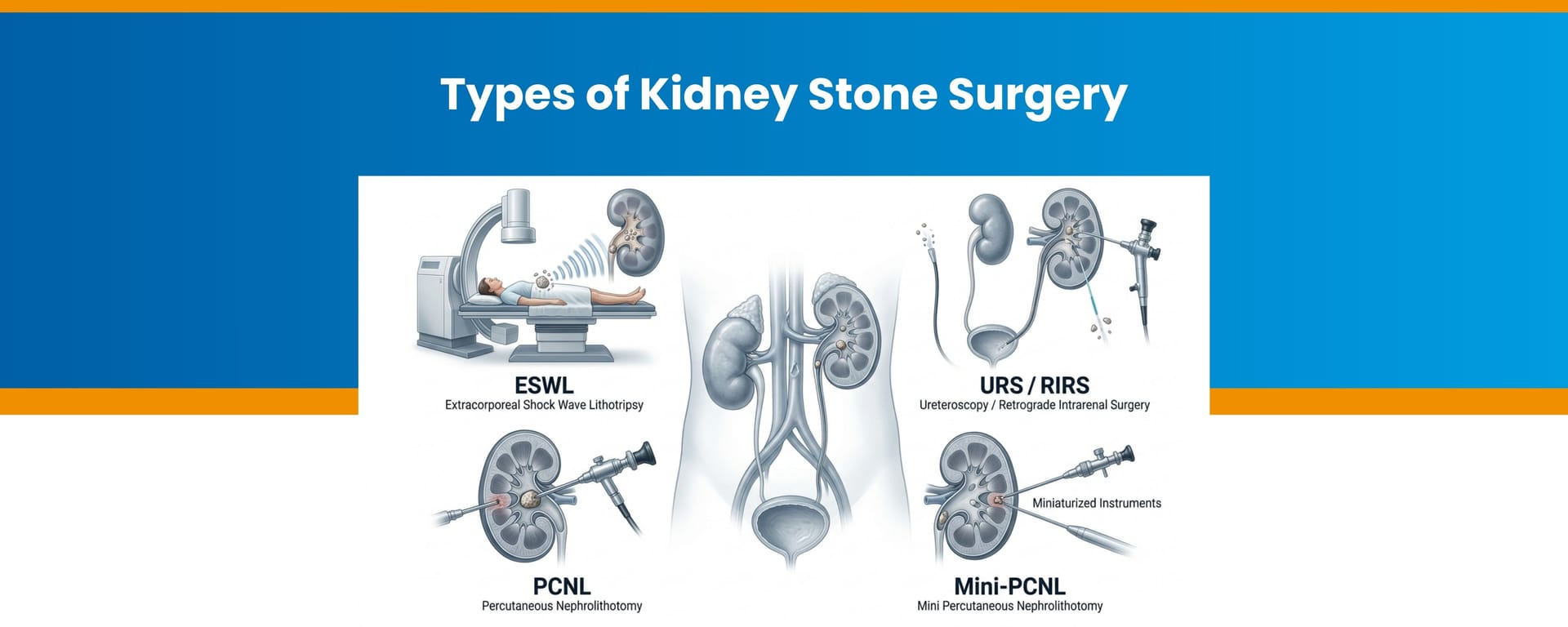
Untreated kidney stones cause debilitating pain and potential renal failure. While minor stones may pass, larger obstructions require a review available types of kidney stone surgery. Laser stone removal, performed during ureteroscopy or RIRS, allows accurate stone treatment.
For larger, more complex stones, PCNL surgery remains the gold standard for high stone-clearance rates in large stones. NU Hospitals delivers expert MiniPCNL procedures, directly reducing the physical impact of surgery through specialised and dedicated clinical care systems. Our focus on accuracy delivers better results, significantly reducing the need for a second operation.
When Is Surgery Required for Kidney Stones?
Surgery is recommended if:
Spontaneous passage is physically impossible
Significant stones rarely navigate the urinary system on their own and may become trapped. Remaining stationary, they act as catalysts for pain and infection. Therefore, surgical removal remains the most reliable method for safely eliminating the blockage.
Symptoms or infections remain unresolved
Chronic severe pain and recurring urinary tract infections necessitate clinical action. Rapid surgical intervention effectively alleviates patient distress, prevents life-threatening sepsis, and ensures that the flow of urine is no longer restricted.
Safeguarding of renal capacity
Stones that cause urinary blockages create back-pressure that can permanently damage kidney tissue. Early surgical intervention is necessary to maintain organ health and prevent the need for more complex surgical alternatives.
Burden of recurrent stone disease
Regular episodes of stone formation can be life-altering. Surgical removal provides a clean slate, improving quality of life and significantly reducing the frequency of emergency medical interventions. The optimal surgical technique is selected based on the stone's size, anatomical position, and overall hardness.
Surgery Type by Stone Size and Location
Understanding which procedure is best suited to a particular stone is the first step in treatment planning.
Stone Size / Location |
Preferred Treatment |
Small kidney stones (<10 mm) |
ESWL or RIRS |
Ureteric stones |
Ureteroscopy with laser |
Medium kidney stones (10–20 mm) |
RIRS or MiniPCNL |
Large or staghorn stones (>20 mm) |
PCNL surgery |
This framework helps doctors select the safest and most effective approach.
Main Types of Kidney Stone Surgery
1. Extracorporeal Shock Wave Lithotripsy (ESWL)
ESWL is a sophisticated, non-invasive option for treating kidney stones. By using precisely focused sound waves, we can break stones into smaller fragments for natural elimination. This procedure is performed as a day-care treatment without the need for incisions or internal scopes.
-
Best for: Small renal stones or proximal ureteric calculi.
-
Advantages: Non-surgical approach, low discomfort levels, outpatient care, and rapid rehabilitation.
-
Limitations: Multiple sessions may be needed; less effective for very large or particularly hard stones.
Recovery is usually rapid. Most patients feel ready to resume their normal daily activities within a few days, though some temporary side effects, such as aching or frequent passage are common.
2. Ureteroscopy and Laser Kidney Stone Surgery
Ureteroscopy involves passing a very thin, flexible scope through the natural urinary passage to directly visualise the stone within the ureter or kidney. Once identified, a Holmium laser is used to break the stone into extremely fine particles using techniques such as fragment dusting or controlled fragmentation. These tiny pieces either pass naturally in urine or are removed during the procedure.
-
Suitable for: Ureteric stones, moderate kidney stones, and ESWL failures.
-
Benefits: Single-session resolution, no incisions or scars, and short recovery time.
Regarding ureteroscopy vs lithotripsy, ureteroscopy is the definitive choice for ureteric stones. Direct visualisation ensures immediate clearance and higher success rates, significantly reducing the necessity for the repeat procedures often required by less direct methods.
3. Retrograde Intrarenal Surgery (RIRS)
RIRS surgery for stones is a minimally invasive procedure for treating deep renal calculi. Using a flexible endoscope, surgeons navigate the natural urinary tract without incisions. The process involves laser stone removal, where a specialised laser fragments the stone into minute particles. These small fragments or fine dust are subsequently expelled from the body through the urine, providing an effective, incision-free solution for patients with small to moderate kidney stones.
Key advantages:
-
Minimally invasive with no incisions
-
Targets stones up to 20 mm
-
Swift recovery and short admission
RIRS is a high-precision procedure that achieves thorough stone clearance while ensuring low risk. Hospitals with specialised urology departments, such as NU Hospitals, consistently deliver strong outcomes. This reflects their use of advanced equipment and the surgeons' focus on both technical excellence and patient selection.
4. Percutaneous Nephrolithotomy (PCNL)
PCNL Surgery is recommended for renal stones measuring 20 mm or more. A small percutaneous incision enables direct kidney access and total stone clearance within a single surgical session.
-
Standard PCNL: Most effective for stones exceeding 20 mm, providing excellent clearance.
-
MiniPCNL: Practised at NU Hospitals using a smaller access tract for better results.
This limited access leads to less bleeding, reduced pain, and a faster PCNL recovery. Patients benefit from earlier mobilisation and a shorter hospital stay compared to the standard approach. By refining the entry size, this technique achieves excellent stone-removal rates while enhancing the overall patient experience and speeding the return to daily activities.
Comparison: ESWL vs Ureteroscopy vs PCNL
Feature |
ESWL |
Ureteroscopy / RIRS |
PCNL |
Invasiveness |
Non-invasive |
Minimally invasive |
Keyhole surgical access |
Best stone size |
Small |
Small-medium |
Large |
Anaesthesia |
Sedation |
General/spinal |
General |
Hospital stay |
Same day |
~1 day |
2-4 days |
Stone-free rate |
Moderate |
High |
Very high |
Recovery time |
Few days |
~1 week |
2-3 weeks |
Recovery Time After Kidney Stone Surgery
Typical healing periods include:
ESWL: 2–3 days
ESWL is non-invasive, so the body heals quickly. Light activity is possible after 2 days. You may pass small stone pieces. Drinking extra water helps this process.
Ureteroscopy or RIRS: about 1 week
Endoscopic procedures require approximately one week for full recovery. Common post-operative symptoms include transient dysuria and stent-related discomfort. Most patients successfully resume their normal routines by day seven.
MiniPCNL: 1–2 weeks
MiniPCNL uses a smaller entry point into the kidney, which helps you heal faster. Most people are walking comfortably within a few days and return to full activities within 1 to 2 weeks. The exact timing depends on your general fitness and the size of the stone treated.
Standard PCNL: up to 3 weeks
Because this procedure requires a larger access path, your body may take up to 3 weeks to fully recover. You must focus on resting and looking after the small wound on your back. Avoid heavy lifting until your consultant confirms you have healed.
Drinking water, taking prescribed medicines, and attending follow-up scans are necessary to ensure the stones are completely gone and that you have healed safely.
Outcomes and Success Rates
Recent progress in endoscopic and laser technology has led to better patient outcomes:
High success with Holmium laser treatments
Modern laser systems enable precise stone fragmentation and dusting across a range of hardness levels. This accuracy improves stone-free rates and reduces tissue damage, making these laser-based procedures a reliable choice for modern surgical teams.
Fewer complications due to minimally invasive methods
The application of RIRS and MiniPCNL avoids large incisions, which drastically reduces bleeding and infection risks. These minimally invasive methods ensure shorter hospital stays and safer recovery than traditional open surgery.
Better long-term prevention through metabolic evaluation
Metabolic evaluations diagnose the causes of recurrent stones. Implementing hydration and dietary protocols significantly reduces future risk, securing a path to long-term relief.
NU Hospitals’ urology department is recognised for:
-
Expertise in RIRS, MiniPCNL, and complex stones
Specialist surgeons manage a wide spectrum of stone disease using advanced minimally invasive techniques tailored to each patient.
-
Modern laser platforms for laser kidney stone surgery
High-performance laser equipment ensures precise stone removal, providing the basis for improved surgical outcomes and patient care.
-
Consistently low complication rates
Precision-led protocols and expert urology teams ensure consistently safe patient outcomes.
-
Patient-centred recovery care
Structured follow-up and guidance promote comfortable healing and durable results.
Kidney Stone Removal Cost
The total private kidney stone removal cost is influenced by these four key areas:
-
Procedure type
The choice of approach affects the use of anaesthesia, operating time, and hospital resources. Non-invasive treatments generally have lower associated costs than procedures requiring surgical entry.
-
Hospital facilities and expertise
Specialist hospitals with modern facilities may have higher costs. However, these fees ensure better safety and fewer complications, as expert teams use advanced technology to provide more successful treatments.
-
Need for multiple sittings or stents
Large stones may require repeated sessions or stent placement. These additions, along with subsequent imaging, will affect the final total expense.
-
Insurance coverage
The patient’s insurance provider and specific policy limits significantly determine the out-of-pocket expenses. Confirming what your insurance covers before your operation is the most effective way to protect your finances during recovery.
Generally:
-
ESWL is the least expensive: Because it is non-invasive and usually performed as a day-care procedure.
-
Ureteroscopy/RIRS are mid-range: These involve specialised endoscopic equipment and short hospital admission.
-
PCNL is higher due to surgical complexity: It requires operating theatre time, surgical access to the kidney, and longer recovery monitoring.
Single-session success provides better value through two mechanisms: eliminating follow-up costs and managing future health risks with high efficacy.







