 Nephrology
 Urology
 Andrology
 Fertility (IVF)
 General Nephrology
 Paediatric Nephrology
 Dialysis
 Renal (Kidney) Biopsy
 CRRT
 Peritonial Dialysis
 Robotic Surgery
 Urinary Incontinence
 Uro-Oncology
 Laparoscopic Urology
 Reconstructive Urology
 Anaesthesiology
 Radiodiagnosis
 Nutrition and Dietetics
 Pediatric and Immunization
 Cardiology
 Intensive Care Unit




Introduction
Peritoneal dialysis and hemodialysis are both effective dialysis procedures for patients with End-Stage Renal Disease (ESRD), but they differ in the way blood is filtered, where treatment is delivered, and the degree of lifestyle flexibility they offer. When the functionality of the kidneys reaches an advanced stage, dialysis becomes a life-saving procedure. Patients are often left in a dilemma when they are required to choose between peritoneal dialysis and hemodialysis, because they are unaware of the differences between the two. Let’s get into the details.
Understanding the Types of Dialysis
There are two primary types of dialysis which are generally used. Let’s understand each type in detail.
1. Hemodialysis (HD)
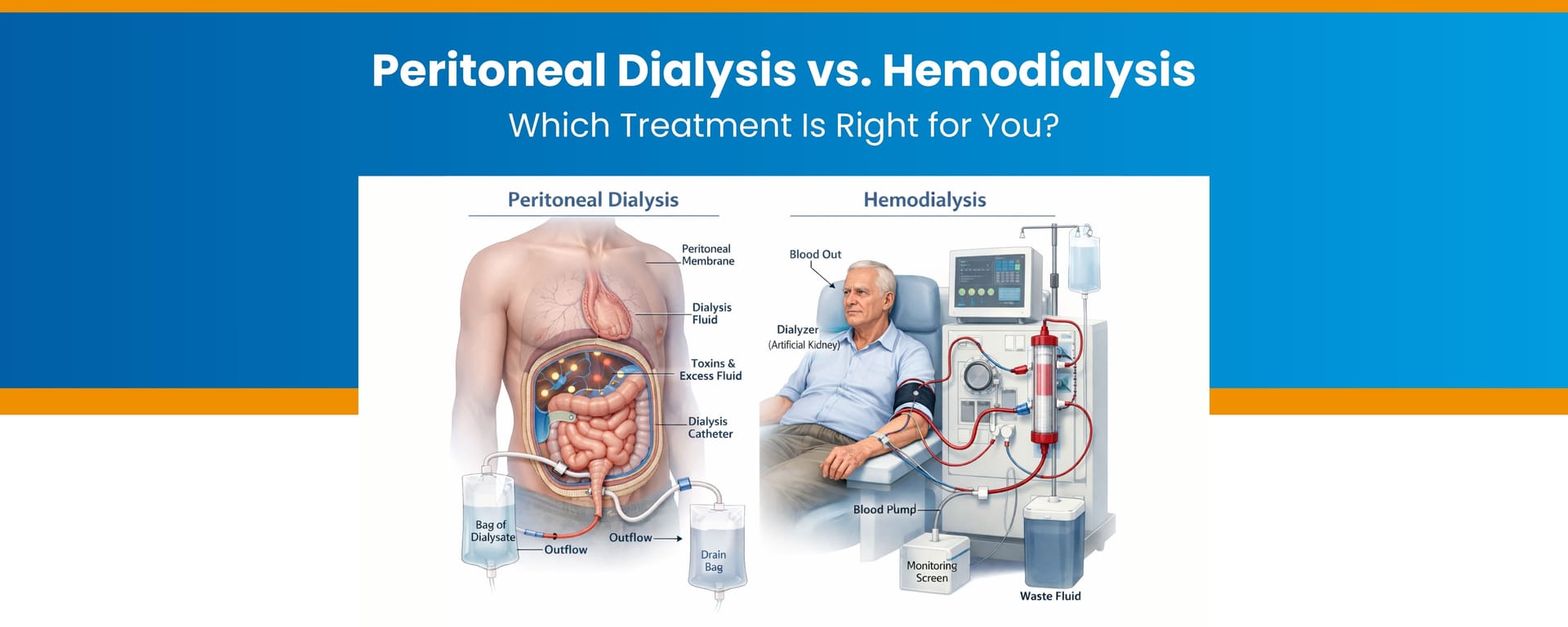
Hemodialysis is a process in which the blood is filtered using a machine and a dialyser outside the body. Blood is removed from the body through a surgically created vascular access, an AV fistula or a central venous catheter (tunneled or nontunneled) (a catheter placed into the big veins of our body in the neck. The blood is then sent through an artificial filter, where waste products are removed, before it is returned to the body.
Hemodialysis is usually done:
-
3 times per week
-
3 to 5 hours per session
-
At a dialysis centre (though home HD options exist)
The process relies on ultrafiltration and diffusion for solute clearance.
2. Peritoneal Dialysis (PD)
Peritoneal dialysis is a procedure where the body’s own lining, or peritoneum, serves as a filter. A thin tube is placed inside the abdomen, and a sterile fluid called dialysate is infused into the abdominal cavity. The fluid draws out the waste products and excess fluid, which is then drained and replaced. Peritoneal dialysis can be performed in the following ways:
-
Continuous Ambulatory Peritoneal Dialysis - manual method
-
Automated Peritoneal Dialysis - via machine mostly at night
PD enables patients to perform dialysis at home.
Peritoneal dialysis is performed:
Daily 3-4cycles if manual method; if via machine through the night (while one sleeps)
Duration in manual method 4hours per each cycle
Technical Comparison: Hemodialysis vs Peritoneal Dialysis
Technical Comparison Table
Understanding the comparison between the two dialysis techniques based on various parameters will help you make an informed choice for your treatment.
Parameter |
Hemodialysis |
Peritoneal Dialysis |
Location |
Primarily in a dialysis centre |
Home |
Access |
AV fistula/ graft / venous catheters |
Abdominal catheter |
Frequency |
3 sessions per week |
Daily exchanges |
Duration |
3 to 5 hours per session |
Continuous or nightly |
Diet Restrictions |
More strict |
More flexible |
Fluid Restriction |
Higher |
Moderate |
Solute Clearance |
Rapid, intermittent |
Continuous, gentle |
Travel Flexibility |
Limited |
High |
Hemodialysis provides rapid clearance but creates fluid and electrolyte shifts in the body between the sessions. Peritoneal dialysis, on the other hand, generally provides steady, continuous clearance. This is why it is gentler on the body than hemodialysis.
Lifestyle Considerations: Which Is Best for an Active Lifestyle?
For patients seeking the best dialysis for an active lifestyle, peritoneal dialysis often offers many advantages over hemodialysis. Some of them include:
-
Greater scheduling flexibility
-
Ability to travel easily
-
No frequent hospital visits
-
Better preservation of residual kidney function
However, patients must be comfortable performing sterile procedures at home. Hemodialysis may suit patients who prefer supervised care in a centre and do not want to manage dialysis equipment independently.
Patient Suitability Matrix
Patient Suitability Comparison Table
Not every treatment technique is suitable for every patient, and not every health condition requires the same type of dialysis. The choice of dialysis treatment primarily depends on the patient’s health profile and its nuances. Let’s take a look at the various patient profiles and how the procedures yield different outcomes for each.
Patient Profile |
Hemodialysis |
Peritoneal Dialysis |
Severe Heart Disease |
May cause fluid shifts |
Gentler, often preferred |
Working Professionals |
Time restrictions |
Flexible scheduling |
Elderly Living Alone |
Safe in-centre |
May need support |
Prior Abdominal Surgery |
Suitable |
May not be ideal |
Independent, Active Lifestyle |
Limited Flexibility |
Highly suitable |
Medical history plays a crucial role in accurately assessing the patient's suitability for the treatment. For example, prior major abdominal surgeries may limit the suitability of Peritoneal Dialysis, while significant instability may favour PD due to steady ultrafiltration.
Is Peritoneal Dialysis Safer Than Hemodialysis?
Both modalities, peritoneal and hemodialysis, have comparable long-term survival outcomes when properly managed. But both have some set of risk factors which should be considered before you make the final decision.
Hemodialysis risk factors include:
-
Drop in / variation in blood pressure during sessions
-
Vascular access complications
-
Fatigue after dialysis
Peritoneal dialysis risk factors include:
-
Peritonitis (infection of the peritoneum)
-
Catheter-related infections
-
Hernias
Infection prevention protocols and proper training are paramount and significantly help in reducing the potential complications of Peritoneal Dialysis.
Can You Switch Between Dialysis Types?
Yes, switching from one type of dialysis to another is possible. Many patients start with peritoneal dialysis and later slowly transition to hemodialysis due to any underlying reasons. Similarly, stable hemodialysis patients might consider switching to Peritoneal Dialysis based on lifestyle needs or vascular access challenges or as suggested by the healthcare professional. The decision is individualised, should involve a nephrologist, and should be changed only after expert consultation.
Does Home Dialysis Require a Full-Time Caregiver?
No, a full-time caregiver is not necessarily always required. Many patients perform peritoneal dialysis independently without a full-time caregiver after structured training and guidance. However, elderly or physically challenged individuals might require assistance from a caregiver to properly perform the dialysis procedure. Modern home dialysis programs include remote monitoring options to ensure patient safety and optimise the smooth functioning of the procedure. It also depends on the patient's personal preferences; if they wish to have a caregiver or need medical assistance during their home dialysis session, it is always better to have one to avoid any impact on the efficiency of your procedure.
NU Hospitals Home Dialysis Support Program
For enhancing the efficiency and effectiveness of your dialysis procedure, whether Peritoneal Dialysis or Hemodialysis, a credible healthcare facility is required. While a good healthcare centre can be extremely beneficial for your condition, a poor choice can create even more difficulties for the patient. The decision thus has to be made with careful consideration and thorough research. When discussing dialysis, NU Hospitals is among the most credible and trusted healthcare institutions for patients. At NU Hospitals, dialysis care goes beyond machines, and the comprehensive Home Dialysis Support Program provides additional benefits and greater ease for patients. Some of the key benefits includes.
-
Structured peritoneal dialysis training modules
-
24/7 remote monitoring facilities
-
Strict infection-prevention protocols to ensure safety
-
Dedicated dialysis nurse helpline
-
High-success AV fistula creation for long-term hemodialysis outcomes
The nephrology team carefully evaluates the patient’s current condition, lifestyle factors, and personal preferences before recommending the most suitable treatment option and a plan of action moving forward. This individualised approach ensures safety, flexibility, and improved quality of life.
Conclusion
Deciding between hemodialysis and peritoneal dialysis is based on medical and lifestyle considerations. Hemodialysis is usually done in a dialysis centre three times a week using an AV fistula and an external dialyser. Whereas peritoneal dialysis is done at home, using the peritoneum in the process of filtering the blood. Both hemodialysis and peritoneal dialysis are equally effective and provide desired outcomes. At NU Hospitals, personalised diagnosis, treatment and home dialysis facilities are provided to help ensure that patients with End-Stage Renal Disease receive patient-centred, efficient care.








