 Nephrology
 Urology
 Andrology
 Fertility (IVF)
 General Nephrology
 Paediatric Nephrology
 Dialysis
 Renal (Kidney) Biopsy
 CRRT
 Peritonial Dialysis
 Robotic Surgery
 Urinary Incontinence
 Uro-Oncology
 Laparoscopic Urology
 Reconstructive Urology
 Anaesthesiology
 Radiodiagnosis
 Nutrition and Dietetics
 Pediatric and Immunization
 Cardiology
 Intensive Care Unit





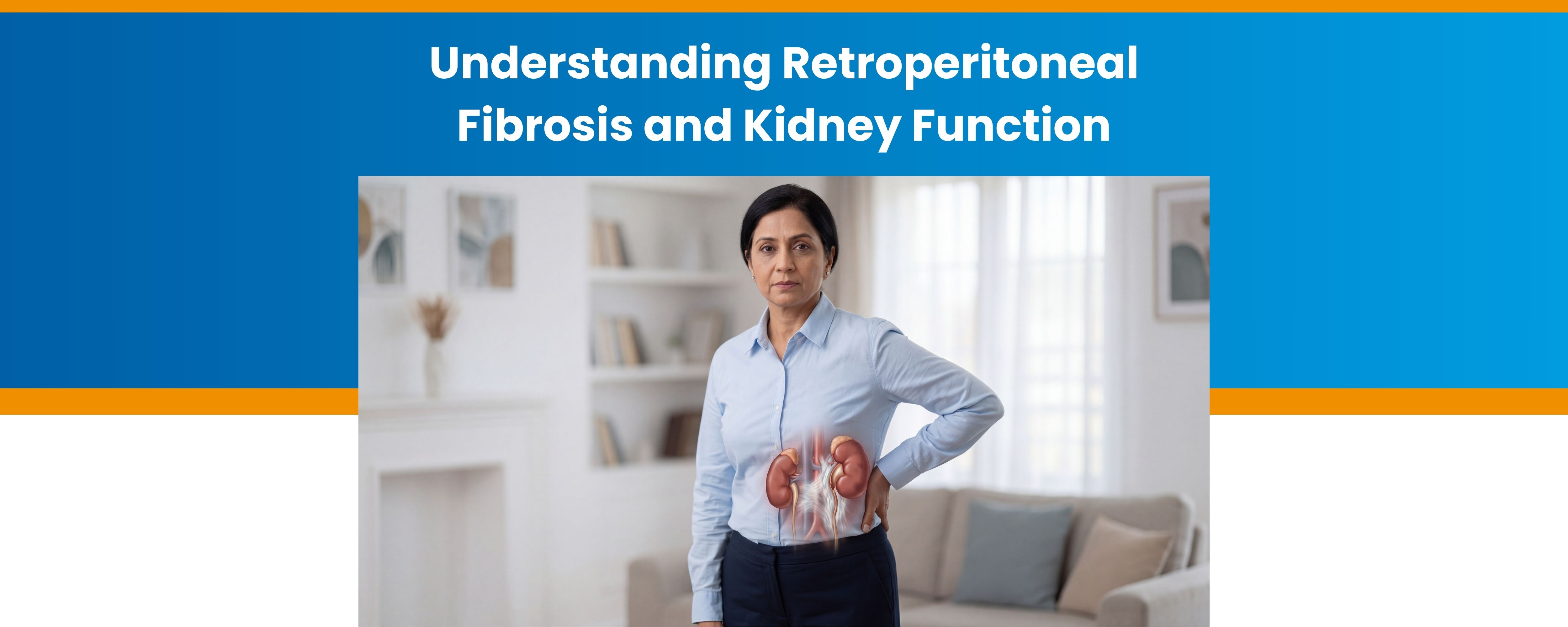
Most of us ignore small, everyday discomforts. Back pain, feeling tired, we don't give importance to it. Unless something feels serious, we do not question what our body is trying to tell us.
But sometimes, these small signs are important to look out for.
There are a few health conditions that build slowly and quietly. One such condition is retroperitoneal fibrosis.
It is a rare but important condition that most people have not heard of. It develops in a space inside your abdomen. It is an area you do not usually think about, as it does not cause any obvious symptoms early. This condition usually goes unnoticed.
Retroperitoneal fibrosis is the formation of extra fibrous tissue ( like scar tissue) around important structures inside your body. It happens especially in the tubes that carry urine from your kidneys to your bladder.
Over time, this can lead to ureteral obstruction. This means the normal flow of urine gets blocked and slowly affects your kidneys.
Early RPF symptoms can feel very common, such as mild back pain and fatigue. Symptoms that most of us would ignore or delay getting checked.
At NU Hospitals, our doctors often see patients who are diagnosed with retroperitoneal fibrosis. However, with the right diagnosis and timely care, this can be managed effectively and sometimes even reversed.
In this blog, we will go through everything you need to know about retroperitoneal fibrosis, RPF symptoms, and retroperitoneal fibrosis treatment.
What Is Retroperitoneal Fibrosis?
Meaning and Overview of This Rare Condition
Retroperitoneal fibrosis is also known as Ormond's disease. It is a rare disorder. It involves abnormal tissue growth in your retroperitoneum (space behind the stomach).
This tissue is mostly non-cancerous. However, it can still cause serious problems. It can be aggressive and choke your nearby organs.
It usually happens slowly and goes unnoticed at first.
How Fibrosis Forms Around the Kidneys and Ureters
Inflammation triggers your body to produce excess collagen and scar tissue. This mass spreads like a web. It slowly encircles your ureters (the tubes carrying urine from the kidney to the bladder.
Over time, this tissue tightens and compresses your structures.
Why It Can Affect Kidney Function
-
Blocked ureters can stop your urine flow
-
Urine backs up into your kidneys
-
This increases pressure and damages your kidney tissue
-
Untreated cases can eventually lead to kidney failure
What Causes Retroperitoneal Fibrosis?
Idiopathic (Unknown) Causes
-
Around 70% of retroperitoneal fibrosis cases have no clear cause
-
These are labeled as idiopathic
-
They are usually linked to your immune system dysfunction
Autoimmune and Inflammatory Conditions
-
It is frequently seen as one of the inflammatory kidney conditions that overlap with other conditions.
-
It is commonly linked to vasculitis, lupus, or other inflammatory kidney conditions.
Medications, Infections & Malignancies
-
Medications: Certain medicines for migraines (ergot alkaloids) or high blood pressure are linked to it.
-
Infections: Rare cases follow severe tuberculosis or fungal infections.
-
Malignancies: Some cancers can trigger a "desmoplastic reaction," creating similar fibrous tissue.
Primary vs. Secondary Retroperitoneal Fibrosis causes
Feature |
Primary (Idiopathic) |
Secondary |
Percentage |
Around 70% of cases |
Around 30% of cases |
Main Trigger |
Unknown |
Drugs, Cancer, or Infection |
How Retroperitoneal Fibrosis Affects Kidney Function
Ureteral Obstruction and Urine Flow Blockage
This condition usually leads to ureteral obstruction.
-
Your ureters are thin, muscular tubes.
-
Fibrotic tissue is stiff and does not stretch.
-
It leads to a condition where your urine cannot drain properly
Risk of Hydronephrosis and Kidney Damage
-
Hydronephrosis means swollen kidney.
-
When urine can not drain properly, your kidney expands.
-
Chronic swelling leads to nephron death, leading to kidney damage.
Long-Term Impact on Kidney Health
-
If one of your kidneys is blocked, the other might compensate for some time.
-
If both are affected, it can lead to acute kidney injury (AKI).
-
Chronic ureteral obstruction can eventually lead to End-Stage Renal Disease (ESRD).
Symptoms of Retroperitoneal Fibrosis You Should Not Ignore
Early RPF symptoms are quite vague.
Persistent Lower Back or Flank Pain
-
This is the most common sign.
-
The pain is usually dull, aching, and non-radiating.
-
Unlike a kidney stone, the pain does not come and go. The pain is constant.
Reduced Urine Output or Swelling
-
If you notice you are visiting the bathroom less often, take note.
-
Swelling in your legs (edema) can happen if the tissue squeezes the large veins.
Fatigue, Weight Loss, and General Illness
-
As this is an inflammatory kidney condition, you might feel sick.
-
Low-grade fever and loss of appetite are quite common.
-
Anemia (low blood count) usually accompanies chronic inflammation.
How Retroperitoneal Fibrosis Is Diagnosed at NU Hospitals, Bangalore
At NU Hospitals, our doctors use several diagnostic tests to detect this rare condition.
CT Scan and MRI Imaging
-
A CT scan is the best way to see the fibrous mass.
-
MRI helps your doctor see the difference between active inflammation and old scar tissue.
-
It also helps to detect ureteral obstruction early
Blood Tests for Kidney Function
-
Creatinine and GFR help to check how well your filters are working.
-
ESR and CRP help to check for inflammation. It helps to know if the disease is active.
Biopsy (When Needed for Confirmation)
-
Sometimes, a tiny sample of the tissue is needed.
-
This is done to rule out cancer or other inflammatory kidney conditions.
Treatment Options for Retroperitoneal Fibrosis
Your retroperitoneal fibrosis treatment plan at NU Hospitals is drafted keeping in mind your condition.
Corticosteroids and Immunosuppressive Therapy
-
This is the best retroperitoneal fibrosis treatment
-
Helps to reduce inflammation
-
Slows or reverses fibrosis
Ureteric Stenting to Relieve Obstruction
-
A small tube is inserted into your ureter
-
Helps to restore urine flow
-
Gives immediate relief from pressure
Surgical Options in Severe Cases
-
Ureterolysis surgery
-
Helps to free your ureters from fibrous tissue
-
Used when medications do not work
Can Retroperitoneal Fibrosis Be Reversed?
Importance of Early Detection
-
Early stages are often reversible
-
Timely care can prevent kidney damage
Managing Disease Progression
-
Regular monitoring
-
Take medicines as prescribed
-
Lifestyle adjustments
Long-Term Monitoring and Follow-Up
-
Go for periodic scans and kidney function tests
Expert Kidney Care at NU Hospitals, Bangalore
NU Hospitals has a team of world-class urologists and nephrologists. We focus on accurate diagnosis, advanced treatment, and long-term care. You will receive personalized care, making sure you get the best outcomes and a smoother treatment.
At NU Hospitals, you get:
-
Multidisciplinary Approach for Rare Kidney Conditions
-
Advanced Imaging and Interventional Care
-
Personalized Treatment Plans







