 Nephrology
 Urology
 Andrology
 Fertility (IVF)
 General Nephrology
 Paediatric Nephrology
 Dialysis
 Renal (Kidney) Biopsy
 CRRT
 Peritonial Dialysis
 Robotic Surgery
 Urinary Incontinence
 Uro-Oncology
 Laparoscopic Urology
 Reconstructive Urology
 Anaesthesiology
 Radiodiagnosis
 Nutrition and Dietetics
 Pediatric and Immunization
 Cardiology
 Intensive Care Unit




Introduction
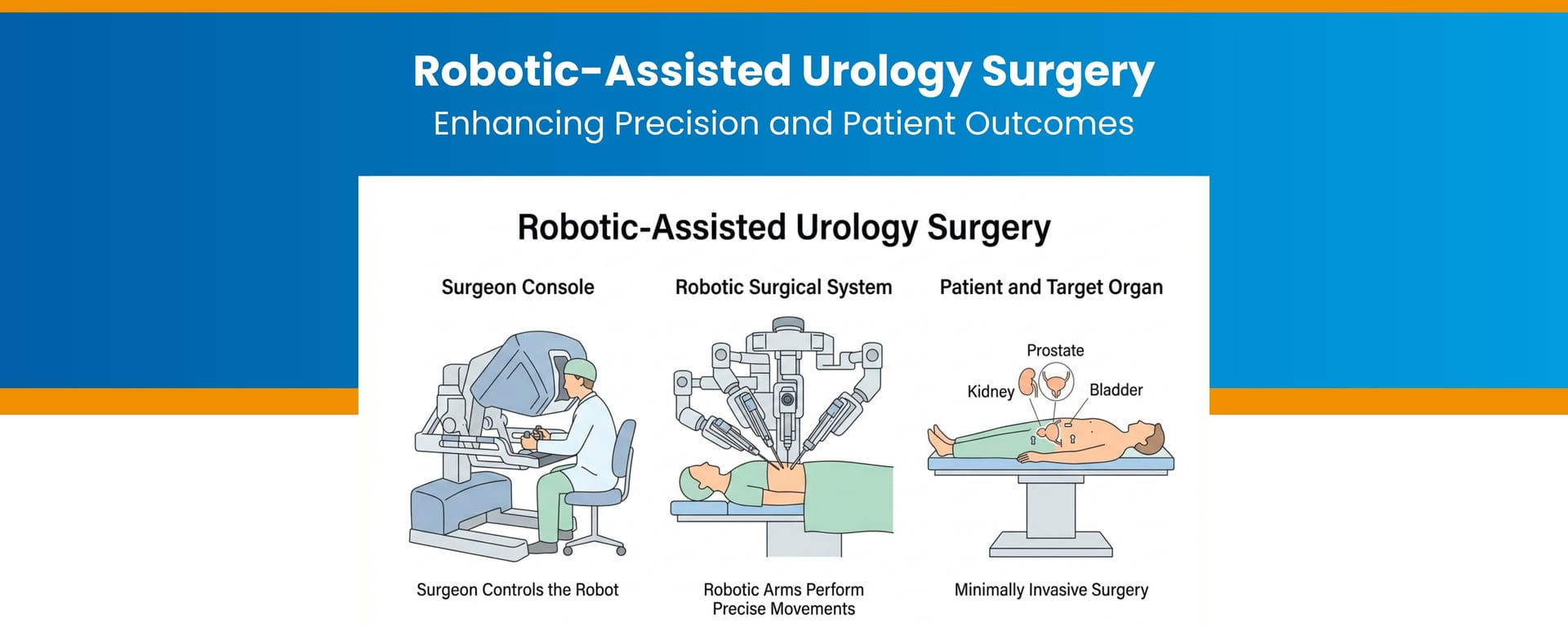
Surgical care in urology has changed steadily over the past two decades. What once required large incisions and prolonged hospital stays can now often be performed through small access points with faster recovery. Among these advances, robotic-assisted urology surgery has become an important tool for managing prostate, kidney, and bladder conditions.
Robot-assisted urology surgery is a minimally invasive approach now widely used for prostate, kidney, and bladder procedures. Using platforms such as the Da Vinci system, surgeons operate with magnified three-dimensional vision and flexible instruments that support precise nerve preservation and careful tissue handling. Compared with open surgery, robotic procedures are commonly associated with less blood loss, shorter hospital stay, and quicker recovery, while maintaining reliable cancer control and functional outcomes in prostate, kidney, and bladder surgery. Surgeon experience and proper patient selection remain essential.
What Is Robotic-Assisted Urology Surgery?
Robotic-assisted surgery is a minimally invasive approach in which operations are performed through small incisions rather than a large incision. Small ports are created through which fine instruments and a high-definition camera are introduced into the body. The surgeon does not stand at the operating table in the traditional sense but instead sits at a nearby console, viewing the operative field in magnified three-dimensional detail and guiding the robotic arms throughout the procedure.
In conventional laparoscopy, instrument movement can feel somewhat restricted because the tools pivot at the abdominal wall and operate on a fixed axis. Visualisation is also typically two-dimensional. Robotic platforms were developed to overcome these practical limitations. They provide three-dimensional high-definition magnified visualisation, articulated wristed instruments with a greater range of motion, tremor filtration, and motion scaling that converts broader hand movements into fine internal actions.
The system translates the surgeon’s hand movements into intuitive motion at the instrument tips, allowing controlled dissection in narrow or deep anatomical spaces where precision is critical.
It is equally important to understand that the robot does not function on its own. It does not make independent decisions. Every movement is initiated and guided by the operating surgeon.
Why Robotics Is Particularly Valuable in Urology
Many urologic procedures take place in deep or narrow spaces. In prostate surgery, for example, the gland lies close to delicate nerve bundles responsible for continence and erectile function. The margin for error is small.
During prostate cancer surgery, identifying and preserving microscopic neurovascular structures requires steady magnified vision and controlled dissection. Even minimal traction or less controlled handling can affect functional recovery after surgery. For that reason, careful dissection around these delicate structures is essential. The robotic platform provides a magnified view and instrument articulation that allow the surgeon to work more steadily, supporting nerve preservation and helping limit intraoperative blood loss.
In kidney surgery, the tumour may lie very close to major blood vessels or the central collecting system. Removing it while preserving as much healthy kidney tissue as possible calls for thoughtful planning and controlled execution. In such situations, improved visualisation and finer instrument movement can assist the surgeon when operating within these confined anatomical spaces.
Common Robotic Urologic Procedures
1. Robotic Radical Prostatectomy
Robotic radical prostatectomy is among the most frequently performed robotic operations in urology and is commonly used for patients with localised prostate cancer.
Some of the commonly observed benefits of robotic prostatectomy are:
-
Enhanced visualisation of the neurovascular bundles
-
Improved precision during nerve-sparing dissection
-
Lower intraoperative blood loss in many cases
-
Shorter hospital stay for most patients
-
Earlier return to routine activity compared to traditional open surgery
From an oncologic perspective, cancer control is influenced by tumour stage, grade, and surgical expertise. In experienced hands, robotic prostatectomy provides oncologic outcomes comparable to open surgery, while also supporting gradual recovery of urinary continence and sexual function over time.
Hospital stay is typically brief. A urinary catheter is generally removed within seven to ten days. The return of urinary control differs from person to person. Some men recover within a few weeks, while for others it may take longer, depending on age, prior bladder function, and details of the surgery.
2. Robotic Partial Nephrectomy
When a kidney tumour is small or confined to one area, surgeons usually try to remove only the growth and leave the rest of the kidney untouched whenever possible. This operation is known as robotic partial nephrectomy.
The operation typically involves:
-
Tumour removal with safe margins
-
Temporary control of the kidney’s blood vessels
-
Repair of the remaining kidney tissue
Warm ischemia time, the short period when blood flow to the kidney is paused for tumour removal, is carefully monitored. Surgeons try to keep this interruption as short as possible to help preserve kidney function.
With a magnified three-dimensional view and greater instrument mobility, the robotic system can make work in tight spaces steadier and more precise. For patients with diabetes, hypertension, or existing kidney impairment, protecting remaining kidney function has significant long-term implications.
3. Robotic Radical Cystectomy
In selected patients with muscle-invasive bladder cancer, robotic radical cystectomy may be performed. The bladder is removed along with regional lymph nodes, and a urinary diversion is created.
Although this remains a major operation, the minimally invasive approach can reduce blood loss and wound-related complications. Oncologic outcomes are comparable to open surgery when performed in experienced centres.
Comparison of Surgical Approaches
When comparing robotic vs laparoscopic urology approaches, important differences become evident in visualisation, instrument flexibility, surgeon ergonomics, and overall precision.
Open vs Laparoscopic vs Robotic Surgery
Feature |
Open Surgery |
Laparoscopic Surgery |
Robotic Surgery |
Incision Size |
Large |
Small |
Small |
Visualization |
Direct view |
Two-dimensional camera |
Three-dimensional high-definition view |
Instrument Movement |
Natural hand |
Limited range |
Wrist articulation with greater flexibility |
Blood Loss |
Generally higher |
Moderate |
Often lower |
Hospital Stay |
Longer |
Shorter |
Often shorter |
Recovery Time |
Slower |
Faster than open |
Frequently faster |
Nerve-Sparing Precision |
Depends on exposure |
Technically demanding |
Enhanced visualisation and controlled dissection |
Outcomes ultimately depend on surgical experience and patient selection. Advanced tools assist the process, yet decisions still depend on the surgeon’s experience.
Why Robotics Improves Outcomes in Key Procedures
Common Robotic Urology Procedures and Clinical Advantages
Procedure |
How the Robotic Approach May Help |
Radical Prostatectomy |
Improved visibility in the deep pelvic cavity, support for nerve-sparing dissection, and often reduced blood loss |
Partial Nephrectomy |
Focused removal of the tumour with attention to preserving healthy kidney tissue and careful reconstruction |
Radical Cystectomy |
Better access within confined pelvic spaces, structured lymph node removal, and potentially fewer wound complications in selected patients |
Robotic platforms are intended to improve control and visualisation during complex steps. They support the surgeon during technically demanding steps, yet choices about margins, nerve preservation, and reconstruction are ultimately guided by experience and intraoperative judgment.
Robotic Surgery Recovery
Because the incisions are smaller and the surrounding tissues are handled more gently, recovery after robotic urologic surgery may feel different from traditional open surgery. Many patients can move around sooner, and some notice less discomfort in the early days after the procedure.
Common observations after surgery include:
-
Milder pain at incision sites
-
Less visible scarring
-
A shorter inpatient stay
-
Earlier return to routine activities
Robotic surgery hospital stays are frequently shorter than those for open surgery in appropriately selected cases, allowing earlier discharge and earlier rehabilitation planning.
After robotic kidney surgery, light physical activity is often resumed within two to three weeks, depending on overall health and operative complexity. Following robotic prostatectomy, improvements in urinary control and sexual function tend to occur gradually rather than immediately.
Recovery is not identical for everyone. Age, existing medical conditions, tumour stage, and adherence to follow-up recommendations all influence how quickly patients regain function.
Is Robotic Surgery Safer Than Open Surgery?
Safety is determined by several elements, including the surgeon’s experience, institutional support systems, and patient selection.
Clinical experience suggests that robotic procedures can result in lower blood loss during surgery. Many centres also report fewer wound-related issues and, in suitable patients, a shorter hospital stay. Some patients report less discomfort early on, though recovery differs from person to person.
Robotic surgery is not suitable in every case, and the choice depends on the patient’s condition and the surgeon’s judgment.
Why Robotic Surgery Is Preferred for Nerve-Sparing
During pelvic surgery, protecting delicate nerves is important to preserve urinary control and sexual function.
Robotic platforms provide:
-
Stable magnified three dimensional visualization
-
Fine instrument articulation
-
Controlled traction
-
Accurate dissection along anatomical planes
-
These characteristics support careful nerve preservation, particularly in prostate cancer surgery.
Oncological Outcomes
The primary goal of urologic oncology is effective cancer control.
In appropriately selected patients, robotic surgery has demonstrated cancer control outcomes comparable to those of open procedures. Surgical margin rates and lymph node retrieval are similar when operations are performed in experienced centres, and long-term oncologic outcomes remain closely tied to tumour stage and biology.
Although robotic technology enables refined dissection, final outcomes are influenced by multiple factors, including tumour type, stage at diagnosis, and the surgeon’s expertise.
Cost and Practical Considerations
The cost of robotic prostatectomy and robotic kidney surgery is something patients frequently discuss. The technology can increase initial costs, though a shorter hospital stay and a quicker recovery may offset those costs. Decisions should balance medical benefit, surgeon experience, and patient priorities.
Robotic Expertise at NU Hospitals
At NU Hospitals, robotic-assisted urologic procedures are performed within a structured clinical framework.
The Robotic Centre of Excellence emphasises:
-
Extensive surgeon console experience
-
High rates of successful nerve preservation
-
Low complication profiles
-
Advanced robotic platforms
-
Multidisciplinary oncologic collaboration
Patients frequently search for experienced robotic urologists, and outcomes are closely linked to surgeon console expertise, case volume, and institutional infrastructure.
At NU Hospitals, continuous audits of outcomes and adherence to established clinical protocols are structured to deliver superior oncologic and functional outcomes while maintaining patient safety and long-term quality of life.
Robotic-assisted urology surgery is now widely used in modern practice. With smaller incisions and better visibility, it can address disease while preserving function. Outcomes, however, still depend on surgical expertise, patient selection, and coordinated care.








