 Nephrology
 Urology
 Andrology
 Fertility (IVF)
 General Nephrology
 Paediatric Nephrology
 Dialysis
 Renal (Kidney) Biopsy
 CRRT
 Peritonial Dialysis
 Robotic Surgery
 Urinary Incontinence
 Uro-Oncology
 Laparoscopic Urology
 Reconstructive Urology
 Anaesthesiology
 Radiodiagnosis
 Nutrition and Dietetics
 Pediatric and Immunization
 Cardiology
 Intensive Care Unit




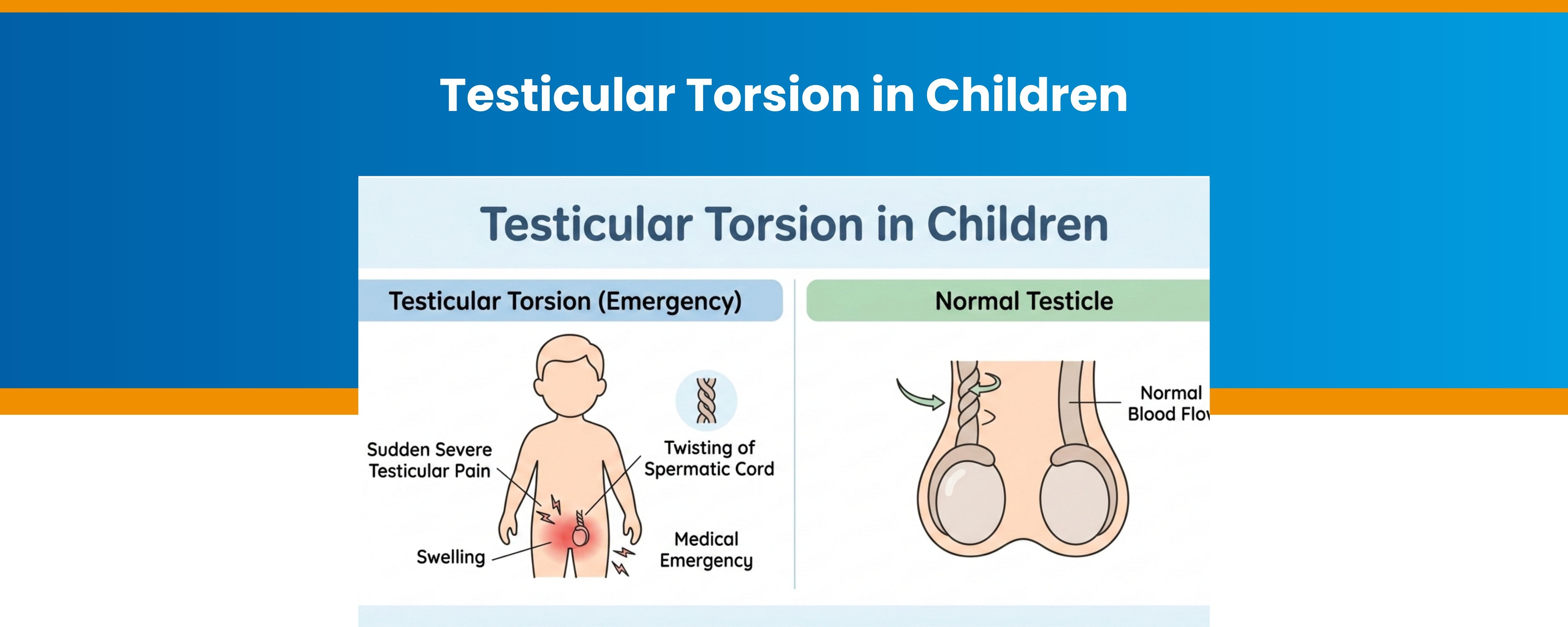
Parents are often unsure how seriously to take testicular or groin pain in a child. In everyday life, aches and pains come and go, and many resolve without intervention. Testicular torsion is one of the few situations where waiting can quietly make things worse. The problem is that it often appears suddenly and without apparent reason, which can be confusing at first.
The condition itself is not common, but it carries urgency because the testis depends entirely on its blood supply. When that supply is interrupted, damage does not wait for days. It begins much earlier. The reassuring part is that when medical care is sought early, children usually recover well and return to everyday life.
At NU Hospitals, management of testicular torsion begins with prompt assessment and open communication with parents. The aim is to act quickly when needed, while ensuring families understand the situation and the reasons behind each decision.
What Testicular Torsion Means in Children
Each testis hangs within the scrotum and is connected to the body by a cord that carries blood vessels and other essential structures. In some children, the testis is more mobile than usual. This increased movement is present from birth and does not cause symptoms on its own.
Testicular torsion happens when a mobile testis rotates around its cord. Once the cord twists, blood flow is reduced. If the twist remains, circulation may stop altogether. The testis cannot tolerate this for long. Unlike infections or inflammation-related swelling, torsion does not improve with rest, medication, or time. It requires physical correction of the twist. This is why doctors treat it as an emergency rather than a condition to observe.
Although torsion is seen more often during adolescence, it can occur at any age, including in newborns. The underlying reason is usually anatomical rather than related to activity or injury.
Common Symptoms of Testicular Torsion in Children: How it Usually Presents
What parents notice first is often pain that starts out of nowhere. It feels different from everyday discomfort, and children are usually able to point to one side more than the other.
Over time, swelling may become visible. Sometimes the scrotum just looks different from usual. One side may feel tighter or appear slightly raised, though the change can be easy to miss at first.
Children do not always point to the scrotum when describing what hurts. Some complain mainly of pain in the lower abdomen. Nausea or vomiting can appear early and may temporarily draw attention away from the actual source of the pain.
In infants and younger children, signs are often harder to pin down. Parents may simply feel that their child is more unsettled than usual, especially during normal handling or care. Subtle differences in the appearance of the scrotum can sometimes be the only outward sign.
Causes of Testicular Torsion in Kids
As for causes, testicular torsion usually occurs when the testis rotates too freely within the scrotum. This increased mobility is often present from birth and may never cause problems until torsion occurs. The episode itself may happen during sleep, while walking, or during routine activity. In many cases, there is no apparent trigger. Minor trauma or physical activity may be reported, but they are not necessary for torsion to occur.
Factors That Increase Risk
Some children are more likely to experience torsion, though many affected children have no identifiable risk factors beforehand.
-
Adolescence is a common time because of growth-related changes.
-
A family history of torsion may also increase risk.
-
An undescended testis or known anatomical differences within the scrotum may also contribute. However, torsion can occur even in children who were previously healthy and asymptomatic.
Children who have experienced brief episodes of scrotal pain that resolve on their own deserve careful attention. These episodes may represent partial twisting that corrected itself temporarily. Even if pain subsides, the risk of a complete torsion remains.
How Doctors Diagnose and Treat Testicular Torsion
Diagnosis is mainly based on clinical assessment.
-
Doctors consider how quickly the pain began, how severe it is, and what the physical examination reveals. Specific findings raise immediate concern and lead to urgent action.
-
Ultrasound with Doppler may be used to assess blood flow when the diagnosis is not precise. That said, imaging is never allowed to delay treatment when suspicion is high. Time matters more than confirmation in such situations.
-
Surgery is the only definitive treatment. During surgery, the twisted testis is untwisted and observed closely. When the testis regains circulation and appears viable, it is fixed in place to prevent the same problem from recurring. The opposite testis is usually fixed at the same time as a precaution, since similar anatomy is often present on both sides.
-
If circulation has been absent for too long and the testis cannot recover, removal may be required.
This outcome is closely linked to the duration of treatment delay rather than to pain severity alone.
Possible Complications and Recovery
The most serious complication is damage to the testis from prolonged loss of blood supply. In some cases, this leads to gradual shrinkage. In others, the testis does not survive.
When treated early, long-term complications are uncommon. Even when one testis has been affected, overall development is usually not disrupted. Even when one testis has been affected, growth and development typically continue without noticeable change. Many children go through puberty as expected.
After surgery, recovery is more gradual and steady. The initial discomfort eases bit by bit, swelling reduces over days, and everyday routines return step by step rather than all at once. School often comes first, while sports and strenuous play are held back a little longer. Follow-up visits are mainly to confirm that healing is moving in the right direction.
Conclusion
For parents, testicular torsion can be distressing because it appears suddenly and requires quick decisions. While the urgency can feel overwhelming, early treatment often yields favourable outcomes.
At NU Hospitals, children who arrive with scrotal pain or vague lower abdominal discomfort are generally assessed early, often before symptoms have had time to evolve further. Much of the initial work involves carefully examining the child, listening to the history, and deciding whether the situation needs immediate action or closer observation. Parents usually hear from the team more than once as things move along, not just at the end. When scans or surgery are involved, things are often discussed again if questions arise.
At NU Hospitals, children receive comprehensive medical care from teams familiar with working with young patients, who naturally approach these situations with extra patience and sensitivity.