 Nephrology
 Urology
 Andrology
 Fertility (IVF)
 General Nephrology
 Paediatric Nephrology
 Dialysis
 Renal (Kidney) Biopsy
 CRRT
 Peritonial Dialysis
 Robotic Surgery
 Urinary Incontinence
 Uro-Oncology
 Laparoscopic Urology
 Reconstructive Urology
 Anaesthesiology
 Radiodiagnosis
 Nutrition and Dietetics
 Pediatric and Immunization
 Cardiology
 Intensive Care Unit




Introduction
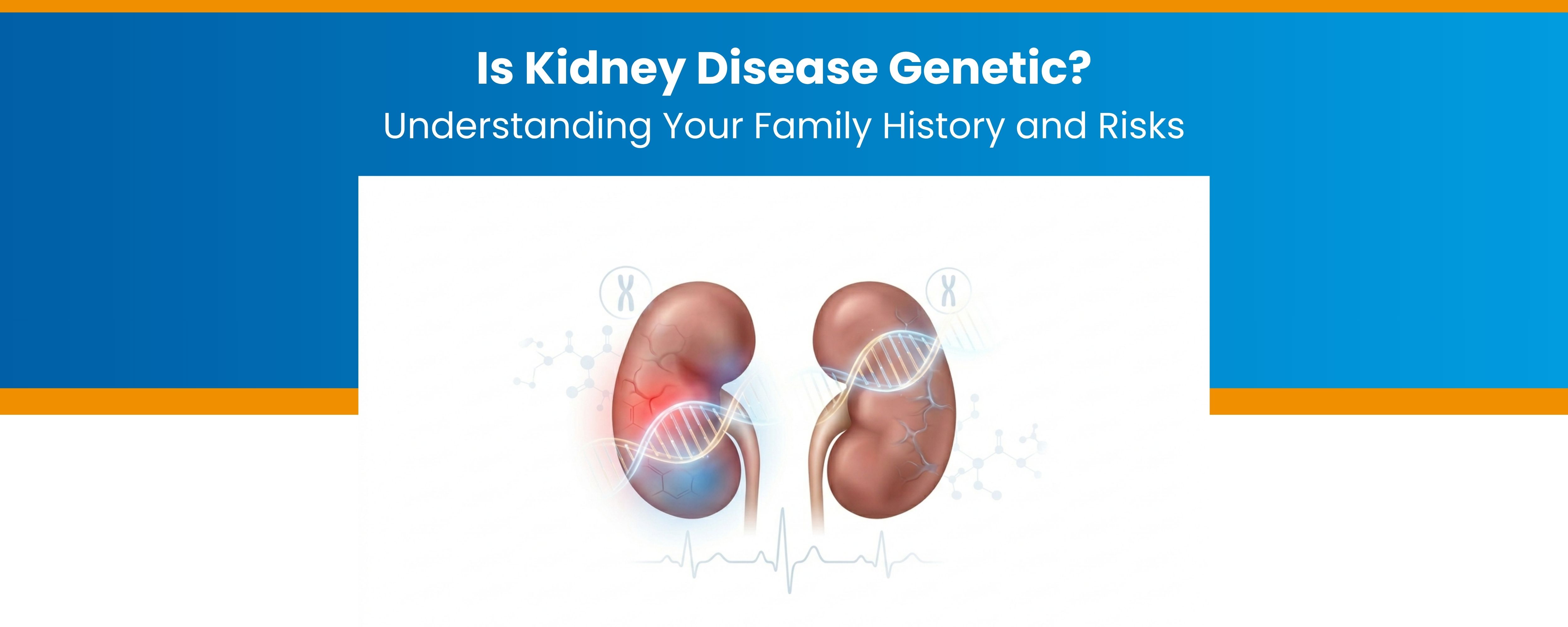
Many people believe that the primary reasons for kidney failure are diabetes, high blood pressure, and poor diet. While these are significant contributors to developing kidney disease, many people overlook the fact that kidney disease can also be inherited. In fact, many types of kidney disease are related to genetics and can be passed down from one generation to the next. If you have a family history of kidney failure, early-onset high blood pressure, or hearing loss, or if any family members require dialysis with no obvious reason, there may be a genetic link.
Early detection is critical for preserving kidney function in the long term, as they have a limited ability to repair themselves when damaged. In addition, advances in genetic sequencing and preventive nephrology now mean that kidney disease can be detected in individuals before they develop symptoms. This opportunity for early detection is helping both physicians tailor treatment for each patient and assisting families in their decision-making process about their health and future.
In this article, we will discuss the science of genetic kidney diseases, the methods of inheritance, how to screen for kidney disease using your family history, and how a specialised program like NU Hospitals' Nephrogenetics Program can assist families in understanding and managing inherited risks to their kidney health.
What is the Relation Between Genetics and Kidney Disease?
Genetics plays a role in many forms of kidney disease. Kidney structure and function can be altered by genetic mutations, which can eventually lead to gradual deterioration of function by altering the filtration membranes, tubules, and supporting tissues of the kidney. There are several important concepts related to genetics:
-
First is 'autosomal dominant inheritance', which means only one parent needs to have an affected gene (with a mutation) to pass it on to his/her child (i.e., the chance of passing on an affected gene is 50%).
-
Second is 'autosomal recessive inheritance', which means a child must inherit two copies of the mutated gene (one from each parent) to be affected.
-
Thirdly, 'phenotype' refers to observable traits (physical characteristics) that can result from a gene mutation.
-
Fourthly, ‘gene sequencing’ refers to analysing the DNA sequence to identify mutations associated with inherited kidney diseases..
Understanding the above-mentioned concepts allows healthcare professionals to assess the risk of developing kidney disease and create individualised management plans.
Common Inherited Kidney Diseases
Many inherited kidney diseases are present, with several having greater prevalence or clinical significance than others.
Alport Syndrome:
Alport syndrome is an inherited condition that alters the structure of collagen found within the filtration membrane of the kidneys and can result in progressive kidney failure, hearing loss, and vision problems.
Polycystic Kidney Disease (PKD):
PKD is one of the most common types of inherited kidney conditions. Mutations in the PKD1 or PKD2 genes significantly increase the risk of fluid-filled cysts, which progressively impair kidney function.
Thin basement membrane disease:
Thin basement membrane disease is characterised by the presence of consistent blood in urine. While it generally has a milder course, the disease may require monitoring.
Congenital Nephrotic Syndrome:
A person gets diagnosed with congenital nephrotic syndrome during infancy or childhood, which results in a large amount of protein being lost through the urine.
Medullary Cystic Kidney Disease:
It is a very rare hereditary illness that may indicate early decline in kidney function and the development of renal cysts.
Inheritance pattern of kidney disorders
Disease name |
Inheritance pattern |
Age of onset |
Important symptoms |
Alport Syndrome |
X-linked/autosomal |
Childhood-early adulthood |
Hematuria, hearing loss |
Autosomal dominant PKD |
Autosomal dominant |
Adulthood |
Enlarged kidneys, hypertension |
Congenital Nephrotic Syndrome |
Autosomal recessive |
Infancy |
Severe proteinuria |
Thin Basement Membrane Disease |
Autosomal dominant |
Childhood |
Microscopic blood in urine |
Medullary Cystic Kidney Disease |
Autosomal dominant |
Young adulthood |
Polyuria, kidney failure |
Symptoms of Genetic Kidney Disease
If any of the following symptoms apply, a possible genetic link exists:
-
More than one person in the family has kidney failure.
-
Multiple individuals required dialysis or underwent transplant at an early age for no apparent reason.
-
There is blood/protein in a person's urine that cannot be explained.
-
There is early-onset hypertension in a person.
-
There are reports of hearing loss/eye issues in conjunction with kidney disease.
-
There is a history of kidney disease in childhood in a family member.
This can help nephrologists determine whether genetic testing should occur.
Diagnosis of Hereditary Kidney Disease
Identifying hereditary kidney disease in its earliest stages through appropriate strategies for assessing increased risk can help to safeguard kidney function. Strategies that are routinely used include:
-
A thorough family history assessment
-
Urine and blood tests
-
Ultrasound imaging
-
Genetic analysis or gene sequencing
Health professionals can monitor individuals more frequently after identifying increased risk for disease, and preventative measures such as controlling blood pressure may be introduced.
Screening Recommendations
Family history scenario |
Screening timing |
Parent diagnosed before age 40 |
Start screening in the teenage years |
Sibling with a hereditary disorder |
Test during early childhood |
Known PKD mutation in the family |
Genetic testing in early adulthood |
Unknown cause of kidney failure in family |
Basic genetic assessment |
Multiple relatives with dialysis |
Immediate kidney evaluation |
Benefits of Genetic Counselling and Testing
Genetic counselling helps you understand inherited kidney disease. The goal of genetic counselling is to inform you about:
Pediatric kidney disease inheritance risk, potential test options, and their outcomes. Through genetic counselling, you may also receive the benefits of:
-
Understanding your family and your own risk of developing kidney disease
-
Understanding how to make decisions regarding having children
-
Learning about early ways to prevent or treat kidney disease
-
Learning about ways to support yourself and your family emotionally
Today, we can perform genetic testing through modern gene sequencing to accurately identify the gene mutation responsible for a person's kidney disease. This precision allows for better diagnosis and the opportunity to develop more individualised treatment plans.
NU Hospitals’ Genetic Counselling Services
The Nephrogenetics clinic at NU Hospitals provides comprehensive evaluation for nephrogenetics patients and their family members.








