 Nephrology
 Urology
 Andrology
 Fertility (IVF)
 General Nephrology
 Paediatric Nephrology
 Dialysis
 Renal (Kidney) Biopsy
 CRRT
 Peritonial Dialysis
 Robotic Surgery
 Urinary Incontinence
 Uro-Oncology
 Laparoscopic Urology
 Reconstructive Urology
 Anaesthesiology
 Radiodiagnosis
 Nutrition and Dietetics
 Pediatric and Immunization
 Cardiology
 Intensive Care Unit




Introduction
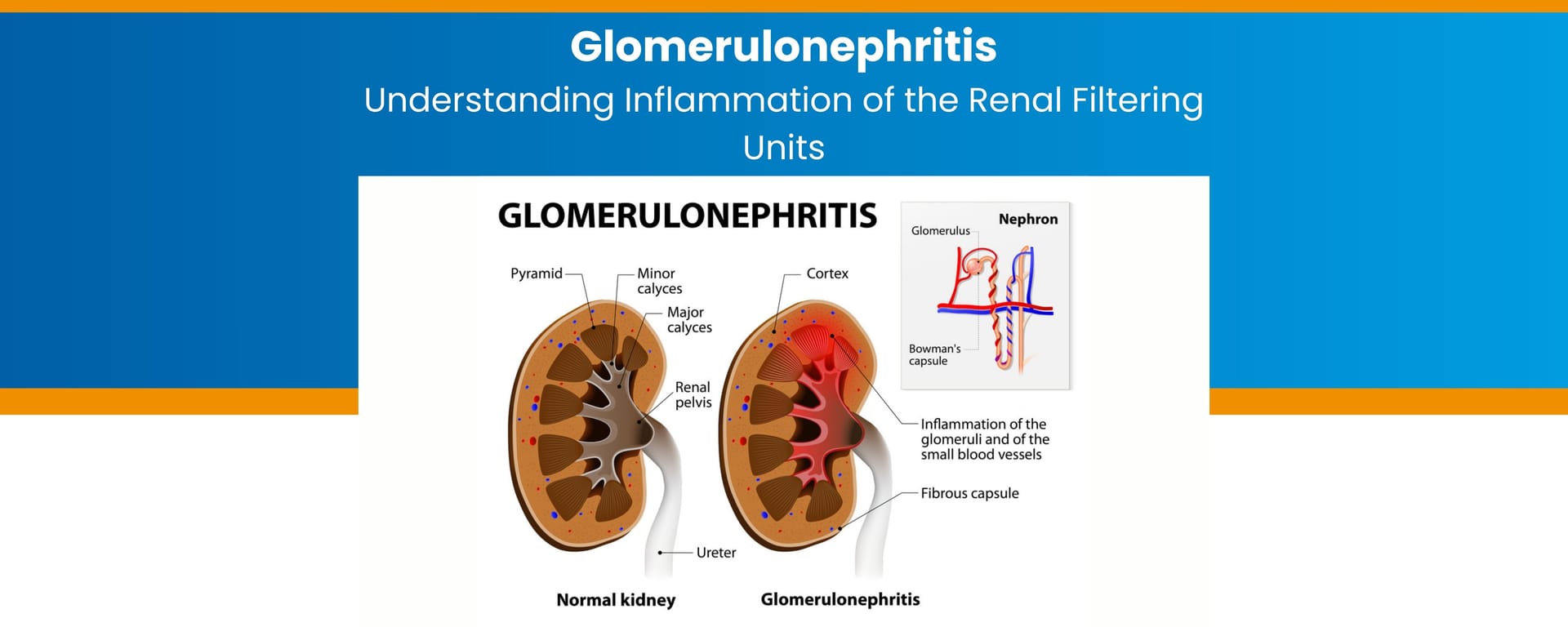
Glomerulonephritis (GN) is a disease that involves inflammation of the kidney's glomeruli (the microscopic filters in the kidneys). Each glomerulus filters waste products and excess fluid from the blood while allowing essential proteins and cells to remain in the bloodstream. When inflammation interferes with this fragile barrier, proteins and blood can leak into the urine; blood pressure rises; swelling develops; and irreversible damage to the kidney occurs. Glomerulonephritis may present as either nephritic syndrome (characterised by hematuria, hypertension, and decreased urinary output) or nephrotic syndrome (excessive protein loss and tissue oedema). When GN is not diagnosed on time and treated appropriately, it may develop into chronic kidney disease (CKD) and ultimately into end-stage renal disease (ESRD). This article provides a complete overview of the causes and symptoms of Glomerulonephritis, diagnostic tests, treatment options, and focuses on the Glomerular Disease Excellence Program offered at NU Hospitals.
Understanding Glomerulonephritis
The glomerulus contains a network of small blood vessels (capillaries) covered by podocytes, special epithelial cells that help filter blood. These cells are supported by mesangial cells and covered by a thin layer of connective tissue that forms the glomerular basement membrane (GBM). Together, these structures create an excellent barrier for filtering blood through the kidneys (glomeruli). The following are common characteristics of glomerulonephritis:
-
The body's immune system targets the glomeruli.
-
Immune complexes become deposited within the kidney.
-
Complement pathways may be activated (evidence may be apparent from abnormal complement levels—C3/C4).
-
Inflammatory cells damage the capillary walls.
-
Blood filtration is altered due to these processes working together.
Depending on the specific pathology, glomerulonephritis (GN) can be acute or chronic, mild or rapidly progressive.
Types of Glomerulonephritis
Glomerulonephritis has three types:
-
Acute glomerulonephritis: Acute glomerulonephritis occurs unexpectedly and often resolves completely with medical intervention.
-
Chronic glomerulonephritis: It can take many months or years to develop and generally doesn't produce noticeable signs until it's at a later stage of illness.
-
Rapidly progressive glomerulonephritis: Rapidly progressive glomerulonephritis develops quickly, leading to a rapid decrease in kidney function.
Table 1: Primary vs. Secondary Glomerulonephritis
Feature |
Primary glomerulonephritis |
Secondary glomerulonephritis |
Origin |
Localised to the kidney (intrinsic) |
Systemic disorder or disease (extrinsic) |
Common Causes |
Idiopathic or unknown |
IgA Nephropathy, Diabetes, SLE (Lupus), infections, medications |
Clinical Presentation |
Generally, nephrotic syndrome is characterised by proteinuria |
Generally, nephritic syndrome is characterised by impaired renal function |
Inflammation (ESR / CRP) |
Generally lower |
Nearly always higher |
Treatment Objective |
Immune system immunosuppressants |
Cause of systemic condition |
Need for Biopsy |
Often recommended to determine the type of glomerulonephritis |
May be necessary to assess severity |
What are the Causes of Glomerulonephritis?
The onset of glomerulonephritis may vary, but its cause is often unknown. The possible causes may include:
-
Complications arising from bacterial endocarditis (an infection affecting your heart valves)
-
Complications associated with infections such as strep throat, Hepatitis C, or HIV
-
Immune system disorders cause your immune system to attack healthy tissues, as seen in conditions such as lupus. Anti-GBM disease, previously known as Goodpasture syndrome, is a group of autoimmune diseases that affects both your lungs and kidneys.
-
IgA nephropathy is a kidney disease caused by an excessive accumulation of the abnormal IgA antibody (immunoglobulin A).
-
Some rare diseases that cause inflammation of blood vessels include granulomatosis with polyangiitis (formerly Wegener's disease), microscopic polyangiitis, Henoch-Schönlein purpura, and eosinophilic granulomatosis with polyangiitis (formerly Churg-Strauss syndrome).
-
Genetic conditions that occur amongst biological families (this form of glomerulonephritis occurs infrequently). Certain subtypes of cancer, for example, multiple myeloma.
Symptoms of Glomerulonephritis
Symptoms of glomerulonephritis may not develop immediately. Eventually, after progressing, you may experience the following symptoms of kidney dysfunction:
-
Anaemia (not enough red blood cells)
-
Hematuria (blood in the urine) that causes the urine to turn pink, red, or brown
-
Fatigue and body aches
-
Lack of appetite
-
Increased blood pressure
-
Proteinuria (protein in the urine) that gives the urine a foamy or bubbly appearance
-
Oedema (swelling) in various areas of the body, including the face, legs, ankles, or abdomen.
-
Nausea, rashes, and shortness of breath
-
Pain or swelling in your joints
-
Urinating more or less than normal (more frequently)
-
Jaundice
-
Unintentional weight loss
If you experience one of these signs, see your doctor as soon as possible. Many illnesses can also cause similar symptoms; therefore, your doctor may assess your symptoms and determine if glomerulonephritis is a possible diagnosis.
Table 2: Nephritic vs Nephrotic Syndrome
Feature |
Nephritic Syndrome |
Nephrotic Syndrome |
Blood pressure |
Increased |
Normal or mild rise |
Hematuria |
Common |
Rare |
Edema |
Mild |
Severe |
Proteinuria |
Mild to moderate |
Heavy |
Urine output |
Reduces |
Often normal |
Diagnosis of Glomerulonephritis
Glomerulonephritis does not have any clear warning signs or symptoms. Therefore, it's usually only diagnosed while you're having tests done for another concern. If your doctor suspects glomerulonephritis, you could be referred to a nephrologist (kidney specialist). The following tests are used to diagnose glomerulonephritis:
-
Urinalysis: This will help determine whether or not there is protein or blood in your urine.
-
Blood tests: Blood is checked for creatinine levels, a waste product your kidneys filter out of the body.
-
Kidney Biopsy: The healthcare professional will use a needle to obtain a tissue sample from the kidney, which will be sent to the laboratory for analysis.
-
Imaging studies (ultrasound, X-ray, CT scan): This will be necessary to evaluate kidney size and shape and to look for any blockages or other underlying causes of glomerulonephritis.
Treatment for Glomerulonephritis
The cause of the condition and whether the kidneys have been damaged will affect how the condition is treated. Treatment aims to prevent further damage. In some cases, treatment involves managing the underlying cause; for example, managing your high blood pressure with medications. Other times, if an infection is present, it can be treated with antibiotics.
-
In other situations, your doctor may suggest changing your diet by reducing your protein and salt intake to reduce pressure on the kidneys.
-
Immunosuppressive drugs may be prescribed if the underlying cause of glomerulonephritis is related to an immune system dysfunction.
-
Using blood pressure-lowering medication, such as angiotensin-converting enzyme (ACE) inhibitors or angiotensin receptor blockers (ARBs)
-
Corticosteroids are given to decrease the amount of inflammation
-
Dialysis is recommended to filter excess fluid, clean the blood, and regulate blood pressure
-
Diuretics are used to reduce swelling and excess fluid in the body
-
Plasmapheresis may be used to remove protein from the blood.
NU Hospitals Glomerular Disease Excellence Program
NU Hospitals' glomerular disease excellence program features a subspecialty approach to glomerulonephritis and other immune-mediated renal diseases. It focuses on diagnosing these patients as quickly as possible, prescribing appropriate glomerular inflammation treatments tailored to their individual needs, and providing long-term care for all patients with glomerular disease through a unified program.
State-of-the-Art Diagnostic Capabilities
-
Extensive autoimmune and serological laboratory tests
-
Ultrasound-guided kidney biopsy
-
Immunofluorescence testing and thorough evaluation of renal pathology
Providing an accurate diagnosis allows for an individualised treatment plan for conditions such as IgA Nephropathy, Membranous Nephropathy, Focal Segmental Glomerulosclerosis (FSGS), and Lupus Nephritis associated with Systemic Lupus Erythematosus (SLE).
Individualised Immunotherapy
-
Use of risk stratification for steroid and immunosuppressive therapy
-
Use of biologic & targeted therapies when appropriate
-
The use of reno-protective medications to slow the progression of kidney disease
Multidisciplinary Care Team
Nephrologists are supported by rheumatologists, pathologists, and other specialists when managing complex secondary causes of kidney disease, such as ANCA-associated vasculitis.
Long-Term Kidney Disease Prevention & Protection
Care is structured to monitor renal function over time, monitor urine protein, monitor blood pressure, and monitor for any signs of relapse to prevent deterioration of renal function resulting from progressive kidney disease, leading to end-stage renal disease or the need for dialysis.