 Nephrology
 Urology
 Andrology
 Fertility (IVF)
 General Nephrology
 Paediatric Nephrology
 Dialysis
 Renal (Kidney) Biopsy
 CRRT
 Peritonial Dialysis
 Robotic Surgery
 Urinary Incontinence
 Uro-Oncology
 Laparoscopic Urology
 Reconstructive Urology
 Anaesthesiology
 Radiodiagnosis
 Nutrition and Dietetics
 Pediatric and Immunization
 Cardiology
 Intensive Care Unit




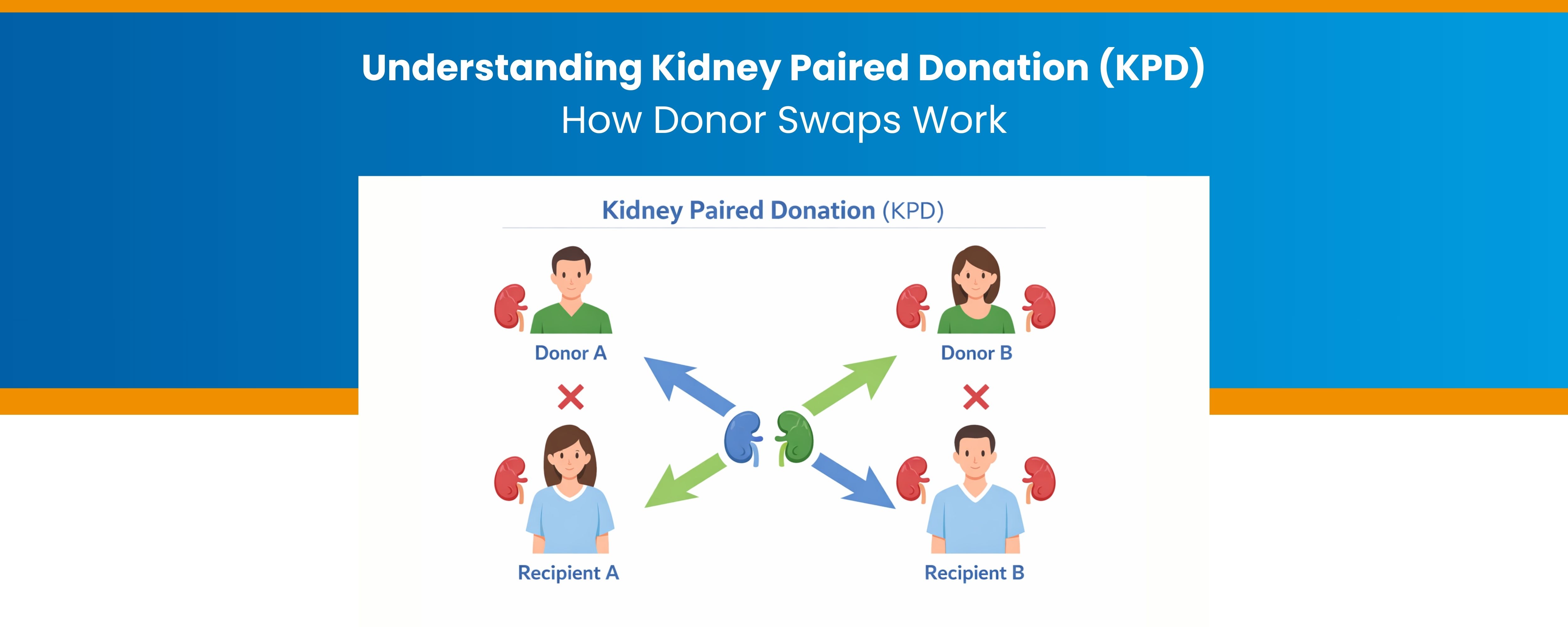
Kidney failure is a massive challenge, but KPD's team-based approach proves that we can overcome it through community effort, offering hope to many patients and families. When one donor-recipient pair hits a wall due to incompatibility, they team up with other pairs through a structured swap program. Your donor helps someone else, and their donor helps you.
This isn't just a medical procedure; it’s a global movement to slash waiting times and maximise the number of living donors. We cannot afford to let compatible organs go unused. This paired approach allows the medical community to provide more life-saving transplants from living donors, successfully bypassing the common biological obstacles that often prevent direct organ donation.
Understanding Kidney Paired Donation
For patients on the transplant waiting list, every day counts. If you have a willing donor who isn't a match, you need to know “What is kidney paired donation (KPD)?” KPD is a revolutionary system that bypasses the incompatibility barrier. Don't wait years for a deceased donor; instead, enter an exchange to swap donors with another pair. This system ensures you receive a compatible living organ, which typically lasts longer and works better.
KPD programs are now creating massive transplant chains, meaning your donor’s gift could trigger five, ten, or even twenty life-saving surgeries. If you are stuck on dialysis because of a medical mismatch, KPD is your fastest route to a new kidney. Talk to your transplant coordinator today about joining a paired donation registry. It is the most proactive step you can take for your health.
How Kidney Donor Swap Works
For those on dialysis, time is of the essence. You need to know how kidney donor swap works to speed up your path to a transplant. Instead of waiting years for a deceased donor, you can join a registry today. The process is fast and efficient: register, get tested, and let the matching software find your swap. Once a compatible pair is found, the system moves quickly toward surgery.
To ensure total fairness, the transplants happen at the same time, meaning no one gets left behind. This is a highly organised, safe, and ethical way to get a compatible living kidney. If you have a willing donor, don’t let a mismatch stop you. A kidney donor swap is the most proactive way to take control of your health and secure a prosperous future.
Types of Kidney Paired Donation Arrangements
KPD works in different ways:
-
Two-way exchange: Two pairs swap their donors so everyone can get a matching kidney transplant.
-
Multi-way exchange: Three or more pairs are linked in a closed donor loop.
-
Donation chains: These begin with a non-directed altruistic donor, allowing a series of transplants across many pairs.
These varied structures are critical for sensitised patients. By using algorithms to create larger networks, the system identifies compatible matches that would be impossible in a simple one-to-one donation.
Benefits of Kidney Paired Exchange
If you are currently on dialysis, you need to understand the benefits of kidney paired exchange right now.
-
Every year spent on a waiting list increases the risk of complications. KPD offers a way to jump the queue by using a willing, albeit incompatible, donor.
-
Living donor kidneys are medically superior. They last longer and work better than deceased donor organs, meaning you get your life back faster and for longer.
-
By joining an exchange, you aren't just helping yourself; you are helping the whole community by freeing up a spot on the deceased donor list.
This is a proactive, safe, and highly successful way to secure a transplant. Don't wait for a miracle on the national list. Use the power of paired exchange to turn your incompatible donor into a compatible success story today.
Eligibility for Kidney Paired Donation
The first step in any transplant journey is determining eligibility for kidney paired donation.
-
This program is created specifically for pairs who face biological barriers, such as different blood types or incompatible antibodies. However, a willing donor isn't the only requirement.
-
Both individuals must undergo standard workups. Screening with blood tests and medical imaging ensures that the donor is physically capable of donating a kidney without adverse health consequences. For the recipient, it means ensuring their heart and lungs can handle the surgery.
-
A final part of eligibility is the legal side. You must be part of an official KPD registry. In India, for example, the law ensures that all swaps are altruistic and transparent.
These safeguards are in place to uphold the dignity of the donor while providing the recipient with the best possible chance at a healthy, dialysis-free life through a compatible exchange.
When Is KPD Recommended
A key part of renal care is identifying when is KPD recommended.
-
Kidney Paired Donation is the standard recommendation when a patient and their living donor are incompatible. This occurs when their blood types don't match or when the recipient’s immune system rejects the donor’s tissue.
-
It is also highly recommended for sensitised patients who have high antibody levels from previous treatments. Because KPD uses living donors, it is a faster alternative to the years-long wait on the deceased donor list.
-
If direct transplants are ruled out, teams propose KPD to secure a compatible organ and speed up the surgical process for the recipient.
Challenges and Limitations of KPD
Kidney Paired Donation has many strengths, but it also faces real challenges that participants should understand.
-
Finding suitable matches can be difficult for patients with rare blood types or extremely high levels of sensitisation.
-
Additionally, coordinating multiple surgeries simultaneously requires logistical precision and experienced transplant teams.
-
There may also be emotional complexities for donors and recipients, particularly when considering donating to or receiving from a stranger.
Dedicated counselling and open dialogue help resolve emotional complexities, ensuring that donors and recipients understand the process and participate in an informed way.
The Future of Kidney Paired Donation
KPD is a testament to how technology can foster human connection. More innovative algorithms and global registries are breaking down the walls of incompatibility. We are even beginning to see a world where borders don't stop a life-saving match. As awareness deepens, Kidney Paired Donation is becoming a symbol of a more connected medical world. It offers a powerful light of hope for patients who once felt isolated by their medical conditions.
Conclusion
KPD uses clever algorithms to avoid blood-type mismatches and other biological barriers that block direct transplants. By coordinating exchanges between multiple pairs, it turns incompatible pairs into compatible ones. Patients should focus on the three pillars: the matching process, eligibility standards, and clinical timing. This structured approach maintains high graft success rates while protecting donor health.
As data-driven medicine advances, Kidney Paired Donation serves as a critical infrastructure for renal care, demonstrating that networked collaboration and donor generosity are the keys to restoring patient health.








