 Nephrology
 Urology
 Andrology
 Fertility (IVF)
 General Nephrology
 Paediatric Nephrology
 Dialysis
 Renal (Kidney) Biopsy
 CRRT
 Peritonial Dialysis
 Robotic Surgery
 Urinary Incontinence
 Uro-Oncology
 Laparoscopic Urology
 Reconstructive Urology
 Anaesthesiology
 Radiodiagnosis
 Nutrition and Dietetics
 Pediatric and Immunization
 Cardiology
 Intensive Care Unit




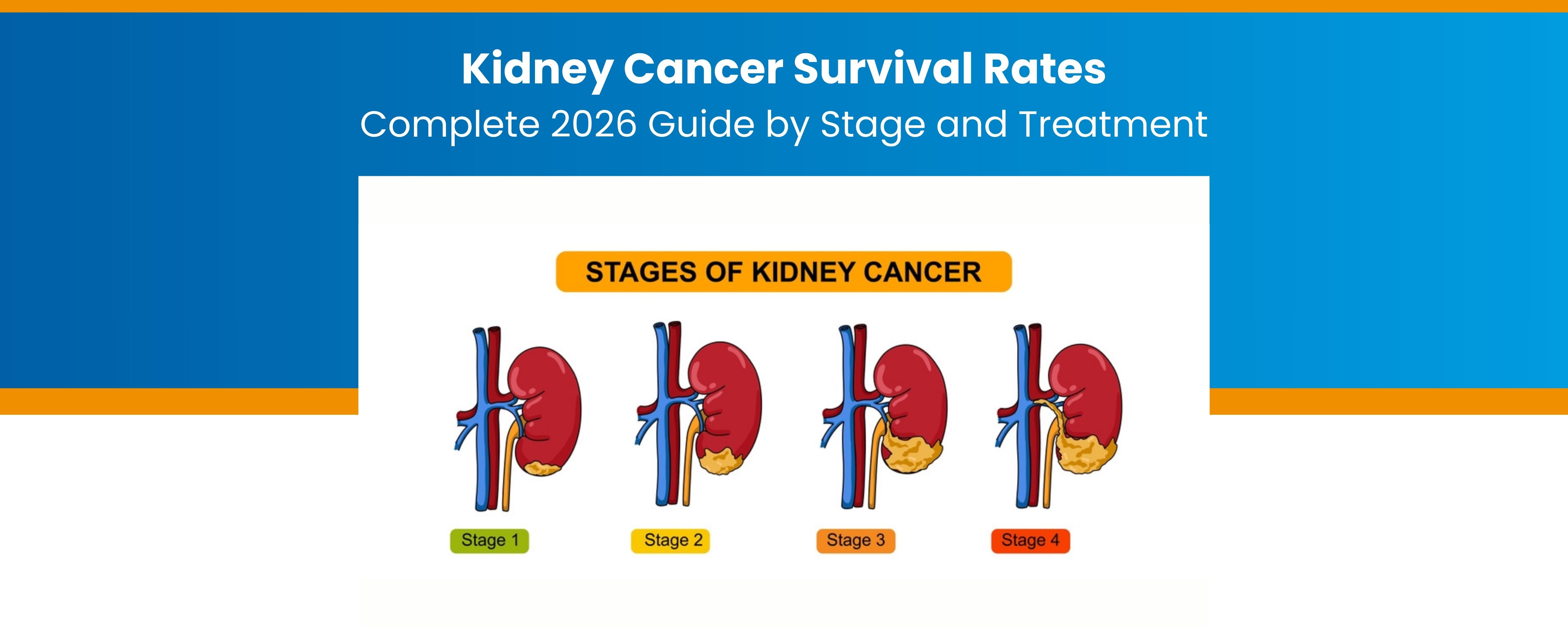
Have you been diagnosed with kidney cancer? Are you looking for kidney cancer survival rates?
We at NU Hospitals understand that this is a very difficult time for you and your family. But don't worry. You are not alone.
It is quite normal to think about your survival rates when you hear about kidney cancer. But kidney cancer is one of the most treatable cancers when caught early. The survival rate of kidney cancer in 2026 is better than before.
Thanks to modern techniques like robotic surgery and immunotherapy, kidney cancer survival rates have seen a rise.
Most patients discover kidney cancer by incidentally, during a scan for back pain, kidney stones, or a routine health check. You might not have any symptoms or warning signs.
At NU Hospitals, Bengaluru, kidney cancer care goes beyond your stage. With our experienced uro-oncology surgeons, advanced robotic systems, and a multidisciplinary approach, you get a personalised treatment.
If you are looking for answers and want to know more, go through this blog.
Kidney Cancer Survival Rates by Stage (2026 Data)
The kidney cancer survival rates depend on when the cancer is found and at what stage it has been found.
5-Year Relative Survival Rates (SEER Data 2015-2021)
Stage |
5-Year Survival |
Key Factor for Success |
Localized (confined to kidney) |
93% |
Surgery is usually needed |
Regional (nearby lymph nodes) |
76% |
Complex surgery and adjuvant therapy |
Distant (metastatic) |
19% |
Immunotherapy & targeted therapy |
All stages combined |
79% |
Early detection is important |
Stage-Specific Prognosis Details
-
Stage 1 (<7cm, confined to kidney):
With a 90% 5-year survival rate, most patients at this stage can return to their normal lives after treatment.
-
Stage 2 (>7cm, kidney only):
Even larger tumors restricted to your kidneys show an 80% 5-year survival rate.
-
Stage 3 (local spread):
If the cancer reaches your veins or nearby lymph nodes, the survival rate is around 70%.
-
Stage 4 (distant mets):
The 5-year survival rate of kidney cancer is around 20%.
Why Survival Rates Have Dramatically Improved
Kidney cancer survival rates have improved due to the medical advances in recent years. However, the survival rates depend on when the kidney cancer is detected and at what stage it has been detected.
It will also depend on the hospital and the doctors you choose for your treatment.
Partial Nephrectomy Revolution
-
Due to the Nephron-sparing surgery, doctors no longer remove your whole kidney if there is no need. Preserving your healthy kidney tissue can reduce your long-term risk of heart disease. This helps improve the outcome of the treatment.
-
Robotic precision is used at NU Hospitals to perform complex robotic surgeries to help achieve the best results for your treatment.
Immunotherapy Breakthroughs
-
The KEYNOTE-564 Study showed a 32% lower recurrence risk when immunotherapy is used after surgery.
-
Combination therapies of Nivolumab and Cabozantinib have also doubled the survival rates for metastatic patients.
Incidental Detection
60% of kidney cancers are found accidentally. They are detected during scans for stones, back pain, or health checkups.
Age-Based Survival Differences
Your age will also play a huge role in your survival rates.
Age Group |
5-Year Survival |
Survival Challenge |
<40 years |
88-93% |
Long-term follow-up |
40–64 years |
82% |
Career and family impact |
65+ years |
72% |
Other medical conditions |
Young patients face higher-grade tumors but excellent surgical cures
Factors That Improve Individual Prognosis
Several factors can improve your survival rates. A few of the factors are listed below:
Tumor Characteristics
Good Prognosis
-
Small tumors that are less than 4 cm
-
Clear cell type
-
Low grade (1–2)
-
Single tumor
Poor Prognosis
-
Sarcomatoid or rhabdoid features
-
High grade (4)
-
Multiple tumors
Patient Factors
-
Being active can fasten your recovery. Therefore, it is advised to do light weight activity every day.
-
Having normal kidney function before surgery.
-
No history of smoking or uncontrolled diabetes can help your body to heal. Avoid smoking and drinking during your treatment for the best results.
Treatment Impact on Survival Rates
Your treatment plan for cancer will also influence your survival rates.
Surgery Type Survival Comparison
-
Partial Nephrectomy gives a 95% 5-year survival. Hence, it is best for small masses.
-
Radical Nephrectomy for larger tumors, removing the whole kidney, gives a 85% survival.
-
Cytoreductive Nephrectomy in metastatic cases removes the primary tumor.
Metastatic Survival: 2026 Reality
-
Favorable risk: Less than 40 months median survival
-
Intermediate risk: 22–27 months
-
Poor risk: 8–12 months
With proper treatment, stage 4 kidney cancer survival rates have increased.
When Survival Statistics Don't Tell Your Story
Each kidney cancer story is different and unique. At NU Hospitals, we give you:
-
Individualized prognosis counseling
Our doctors give you clear and honest guidance on the basis of your cancer type, stage, and overall health. It is not just based on statistics.
-
Second opinions for complex cases
You can get a second opinion on difficult or rare cases to get an accurate diagnosis and the best treatment plan.
-
Survivorship planning (30+ year follow-up)
Your long-term care will be focused on monitoring, quality of life, and staying cancer-free for the years ahead.








