 Nephrology
 Urology
 Andrology
 Fertility (IVF)
 General Nephrology
 Paediatric Nephrology
 Dialysis
 Renal (Kidney) Biopsy
 CRRT
 Peritonial Dialysis
 Robotic Surgery
 Urinary Incontinence
 Uro-Oncology
 Laparoscopic Urology
 Reconstructive Urology
 Anaesthesiology
 Radiodiagnosis
 Nutrition and Dietetics
 Pediatric and Immunization
 Cardiology
 Intensive Care Unit





Overview
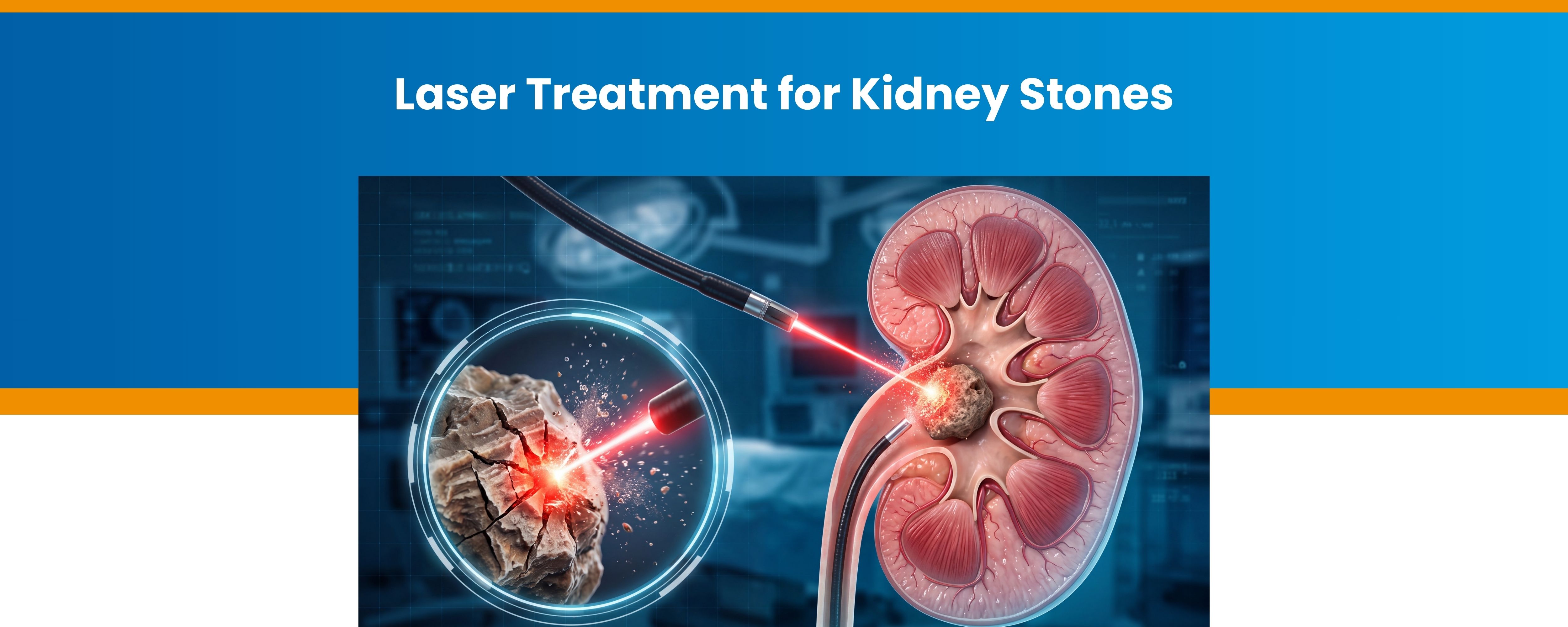
For decades, kidney stones meant either waiting for the searing pain to go away on its own or going under the knife for removal. Now, thanks to advances in medical technology, laser treatment for kidney stones has essentially changed what patients can expect. In many cases, there is no longer a need for incisions or long hospital stays, with stones reduced to dust that the body flushes away naturally.
NU Hospitals is the first in Karnataka to introduce the Holmium Laser. By using RIRS, a modern minimally invasive solution, kidney stones can be broken into fine dust that the body naturally eliminates, without making any incisions, often allowing 24-hour hospital discharge.
What Are Kidney Stones?
Kidney stones form when minerals and salts in the urine crystallise and bind together within the kidneys. There are four types of such stones, including calcium oxalate, uric acid, struvite, and cystine. Kidney stone treatment mainly depends on the size of the stones. Usually, stones smaller than 5 mm often pass through the urinary tract on their own. On the other hand, larger stones require medical intervention, including surgery.
Kidney stone treatment options include:
Treatment |
Best For |
Incision Required |
Stone Size |
Fluids + medication |
Stones smaller than 5mm |
None |
< 5 mm |
ESWL (shockwave lithotripsy) |
Stones up to 15mm |
None |
~15 mm |
RIRS (Laser-Flexible Ureteroscopy) |
Stones up to 15 mm |
None |
Up to 15mm |
PCNL (Percutaneous Nephrolithotomy) |
Large/staghorn stones |
Small |
Any size |
Open Surgery |
Complex or rare cases |
Major |
Any size |
Understanding Laser Kidney Stone Treatment
In laser kidney stone treatment, a small and flexible ureteroscope, which is a thin, fibre-optic tube with a camera at the tip, is inserted into the urethra. Once the device passes through the urethra and reaches the kidney stone, it breaks the stone into tiny fragments. These fragments can then pass naturally in your urine or be retrieved by the surgeons.
What Happens During RIRS Surgery
RIRS, or Retrograde IntraRenal Surgery, is a minimally invasive procedure that is used to remove kidney stones. Here, “Retrograde Intrarenal” is a term simply used to describe the backward movement through the body’s natural urinary tract to reach inside the kidney.
Here are the details that take place during a standard RIRS procedure:
-
Anaesthesia: Usually, a patient undergoing RIRS is placed under general anaesthesia, which ensures the patient does not feel pain during the procedure and during stone fragmentation movement of respiration can be controlled.
-
Scope Insertion: Once the patient is under anaesthesia, a flexible ureteroscope is passed through the urethra, into the bladder, up the ureter, and into the kidney. Unlike other techniques, no incision is made here.
-
Visualisation: The surgeon receives a high-definition, real-time image of the inside of the kidney on a monitor, allowing precise localisation of the stone.
-
Laser Activation: A hair-thin laser fibre is passed through the scope. The holmium laser is activated, delivering accurate pulses of energy directly into the kidney stone.
-
Dusting: In RIRS, instead of breaking the stone into tiny fragments, it is completely pulverised into powder through a technique called “dusting”. This fine powder is then washed away with normal urine flow, and most of the time, the retrieval basket is not needed.
-
Stenting: A ureteric stent is placed temporarily in the ureter to keep it open and allow any remaining debris to pass. The stent is removed after 1-2 weeks.
Generally, the entire procedure takes 45 to 90 minutes, and patients are discharged from the hospital within 24 hours.
Holmium Laser Lithotripsy vs Shockwave
Let’s understand the difference between holmium laser lithotripsy and ESWL (Extracorporeal Shockwave Lithotripsy).
Holmium laser lithotripsy is a minimally invasive and highly effective endoscopic procedure used to break down urinary tract stones of any hardness using a 2100 nm infrared laser. No incision is required here, and the procedure has higher success rates.
On the other hand, ESWL uses external acoustic shock waves directed at the stone from outside the patient’s body. Neither a scope nor anaesthesia is required in ESWL, and while it sounds ideal, ESWL has its own disadvantages. These include:
-
It works better on stones smaller than 10-12 mm in an accessible location.
-
Hard stones can resist shockwaves and may need multiple sessions.
-
Some patients may require 2-3 sessions.
-
Fragments will still need to pass through the ureter, which can be painful.
-
Patients on blood thinners, those with a pacemaker, or pregnant women can't undergo ESWL treatment.
Cost of RIRS Surgery in Bangalore
RIRS surgery in Bangalore can cost a patient anywhere between Rs. 70,000 and Rs. 1,50,000. (It is important to note that the numbers are estimates to give you an idea, and it is best to get a quote from a hospital before making a decision.) Various factors can affect the cost of RIRS surgery in Bangalore, including the size of the kidney stone, the institution, the urologist's experience, the duration of hospitalisation, insurance, and more.
Kidney Stone Diet for Indian Patients
While procedures like RIRS can remove kidney stones, a healthy diet can address the underlying causes of stones in the first place. Drinking plenty of water each day is one of the effective ways to treat and prevent kidney stones, especially in the hot Indian climate. Other fluids, such as unsweetened fresh fruit juices, lemonade, buttermilk, and infused water, can also be beneficial. Increase your citrus intake and make sure to incorporate calcium from dietary sources such as dairy, ragi, and sesame.
Avoid salt (sodium), oxalate-rich foods (spinach, tomatoes, nuts, chocolate, etc.) and concentrated sugary drinks. Animal protein intake should also be limited to twice or thrice a week. You can end the day with one cup of unsweetened milk.
Foods best for kidney stone prevention and management include:
-
Pomegranate
-
Figs
-
Horse gram
-
Banana stem juice
-
Fibre-rich food
-
Beans
-
Green peas
-
Soy
-
Sprouts
What to Expect at NU Hospitals, Bangalore
NU Hospitals is the pioneer of Holmium Laser Lithotripsy and flexible ureteroscopes in Karnataka, having been the first to bring this advanced medical technology to the state. Using the RIRS technique, our urologists turn kidney stones into fine powder and ensure the patient is discharged within 24 hours. By doing so, we have redefined what kidney stone treatment means in the country, making painless stone removal a very real possibility.
Choose NU Hospitals for treating urological conditions in Bangalore and benefit from our team of medical experts, who follow a multidisciplinary approach to achieve optimal outcomes.
Conclusion
The shift toward laser kidney stone treatment has turned a once-dreaded surgery into a quick and manageable procedure. Yes, techniques like RIRS may cost more than the traditional option, but by opting for a path that requires no incisions, you eliminate the need for painful cuts and long recovery periods, making it a suitable option in many cases. Lastly, if you are looking for the best hospital for kidney stone treatment, consult experienced specialists for appropriate treatment.







