 Nephrology
 Urology
 Andrology
 Fertility (IVF)
 General Nephrology
 Paediatric Nephrology
 Dialysis
 Renal (Kidney) Biopsy
 CRRT
 Peritonial Dialysis
 Robotic Surgery
 Urinary Incontinence
 Uro-Oncology
 Laparoscopic Urology
 Reconstructive Urology
 Anaesthesiology
 Radiodiagnosis
 Nutrition and Dietetics
 Pediatric and Immunization
 Cardiology
 Intensive Care Unit




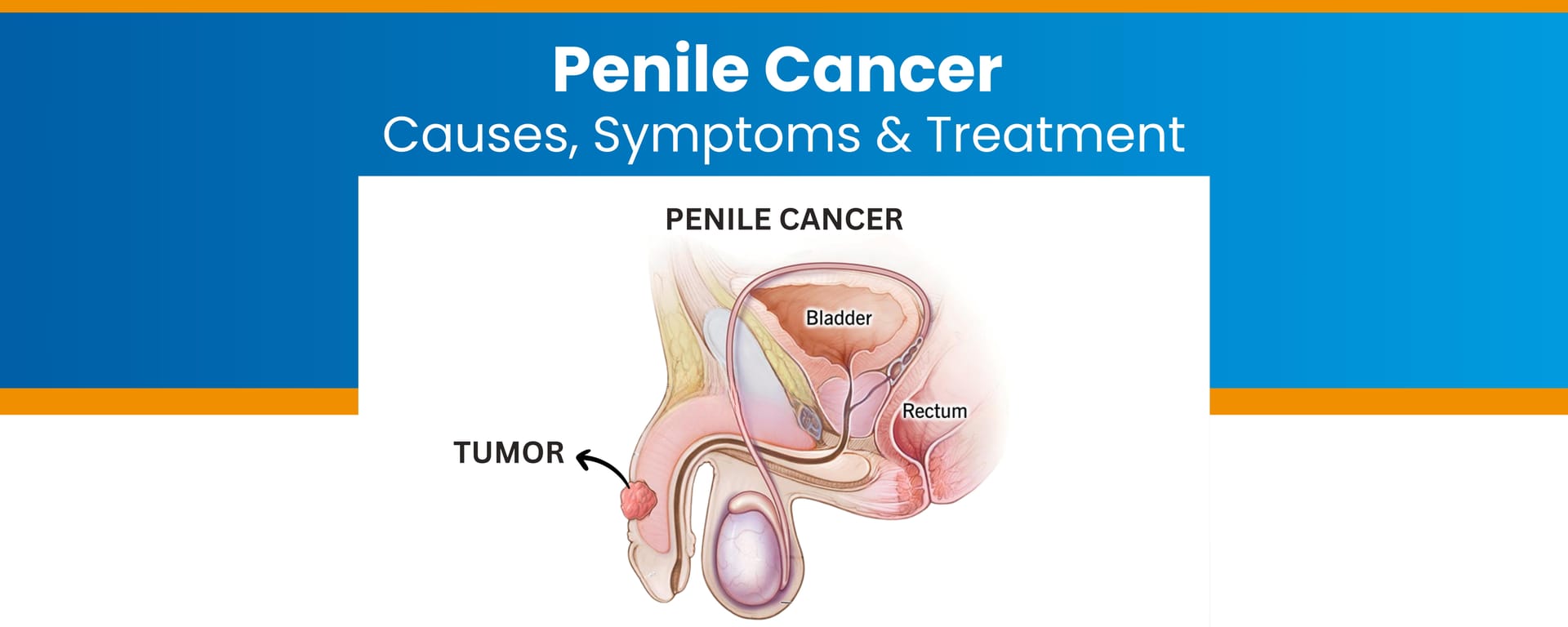
When it comes to your health, certain topics are rarely spoken about. Penile cancer is one such condition that is not openly spoken about. It is a rare condition; however, knowing more about the condition can help you stay safe.
Most men feel uncomfortable speaking about their genital health, but ignoring early warning signs can delay diagnosis and treatment.
Penile cancer can often present itself as lumps or sores, with risk factors being age and uncircumcision. But men, if you are careful and the condition is caught early, penile cancer treatment can be very effective.
This guide will help you learn more about penile cancer, its causes, symptoms, risk factors, diagnosis, and treatment options.
NU Hospitals, Bangalore, is one of the leading urology hospitals and cancer centers. We offer specialized care for all urological cancers.
What is Penile Cancer?
Penile cancer is a rare type of cancer. It starts on the skin of your penis, or within its tissue. The most common type of penile cancer is squamous cell carcinoma. About 90% of the penile cancer cases are squamous cell carcinoma.
This condition affects mostly men above the age of 50. It usually begins as a small penile growth. However, over time, it may spread to nearby tissues or lymph nodes.
What are the Types of Penile Cancer
There are several different kinds of penile cancer; however, most are squamous cell carcinomas. The different types are:
-
Squamous Cell Carcinoma:
Squamous cell carcinoma is the most common type of penile cancer. They grow slowly and are often found on the head or foreskin.
-
Carcinoma in Situ (CIS):
Carcinoma in situ is a non-invasive form of squamous cell cancer. The cancerous cells are limited to the top layer of your skin.
-
Melanoma
Melanoma is a rare cancer that develops in the cells that produce your skin pigment. It is more commonly associated with sun exposure, and it can occur on the penis and has a tendency to spread quickly.
-
Basal Cell Carcinoma
Basal cell carcinoma is another type of skin cancer. It grows slowly and is less likely to spread to other parts of your body.
-
Sarcoma
Sarcoma is a very rare type of cancer. It develops in the connective tissues of your penis, such as blood vessels or muscle.
What are the Signs and Symptoms of Penile Cancer
Recognizing the signs of penile cancer symptoms early is the best way for successful treatment. You must stay aware and consult with a doctor as soon as you notice any of the following signs.
-
A growth, sore, or ulcer on your penis that doesn't heal within a few weeks.
-
A change in skin color on your penis, such as redness, a rash, or brown/blueish patches.
-
A lump or thickening of the skin on your penis.
-
A foul-smelling discharge from under your foreskin.
-
Bleeding from your penis or under the foreskin.
-
Pain in your penis or around its tip.
-
Swelling at the end of your penis.
-
Lumps or swelling in your groin area.
Risk Factors for Developing Penile Cancer
Knowing about the risk factors of penile cancer can help you stay aware. A few of the common penile cancer causes that increase your risk factor are:
-
Human Papillomavirus (HPV)
Certain high-risk strains of HPV, a common sexually transmitted virus, are linked to penile carcinoma cases.
-
Being Uncircumcised
Men who are uncircumcised and have poor hygiene may have an increased risk. This is because a substance called smegma can build up under the foreskin, which can lead to inflammation.
-
Phimosis
Phimosis is a condition where the foreskin is too tight to be retracted over the head of the penis. This can lead to irritation and an increased risk of infection.
-
Smoking
Tobacco use is linked with this type of cancer.
-
Age
Penile cancer risk increases with age, with most cases occurring in men over 60.
-
Poor Personal Hygiene
Not cleaning the penis, especially under the foreskin, can lead to chronic irritation and inflammation.
-
Psoriasis Treatment
In certain rare cases, some treatments for psoriasis have been linked to an increased risk.
How is Penile Cancer Diagnosed
The first step towards effective treatment of penile cancer is to get a proper penile cancer diagnosis.
-
Physical Examination
Your doctor will perform a thorough examination of your penis and your surrounding lymph nodes.
-
Biopsy
A biopsy is a positive way to diagnose penile cancer. A small tissue sample from your lesion will be taken and examined under a microscope for cancer cells. This is a key step in diagnosing a penile cancer.
Scans such as CT, MRI, or ultrasound may be used to see if the cancer has spread to other parts of your body, such as the lymph nodes in the groin.
-
Sentinel Lymph Node Biopsy
The sentinel lymph node biopsy procedure helps to identify and remove the first lymph node that is drained from your cancerous area to check if cancer has spread.
Advanced Penile Cancer Treatment at NU Hospitals
Your penile cancer treatment will depend on the stage and size of your cancer. Your treatment for penile cancer will include:
1. Surgery:
-
Circumcision is done if cancer affects only the foreskin.
-
Local excision is done to remove cancer tissue only.
-
Mohs surgery is a procedure of layer-by-layer removal.
-
Partial penectomy is the removal of part of the penis.
-
Total penectomy might be required in advanced cases.
2. Radiation Therapy:
-
Radiation therapy uses high-energy rays to destroy cancer cells.
-
It is often used when surgery is not possible.
3. Chemotherapy:
-
Chemotherapy medications kill cancer cells.
-
It can either be topical (applied to skin lesions) or systemic (oral or IV).
4. Targeted Therapy & Immunotherapy:
-
Targeted therapy and immunotherapy help boost your immune system to fight cancer.
-
It is used in advanced or stubborn cases.
The perfect penile cancer treatment for you is a decision that your oncologist will make along with you.
Penile Cancer Symptoms, Causes & Treatment
Symptoms |
Causes |
Treatment |
|
|
|
Most men often hesitate to talk about their intimate health. But when it comes to your health, nothing should be off the table. A small sore or penile lesion can be harmless, or it can be the start of something serious.
The only way to be sure is by getting checked. If you have noticed any of the above-mentioned penile cancer symptoms, do not hesitate to consult with a doctor. At NU Hospitals, we prioritize your health. We are a leading men's health clinic in Bengaluru.
When it comes to cancer, the earlier you act, the better your chances are.








