 Nephrology
 Urology
 Andrology
 Fertility (IVF)
 General Nephrology
 Paediatric Nephrology
 Dialysis
 Renal (Kidney) Biopsy
 CRRT
 Peritonial Dialysis
 Robotic Surgery
 Urinary Incontinence
 Uro-Oncology
 Laparoscopic Urology
 Reconstructive Urology
 Anaesthesiology
 Radiodiagnosis
 Nutrition and Dietetics
 Pediatric and Immunization
 Cardiology
 Intensive Care Unit





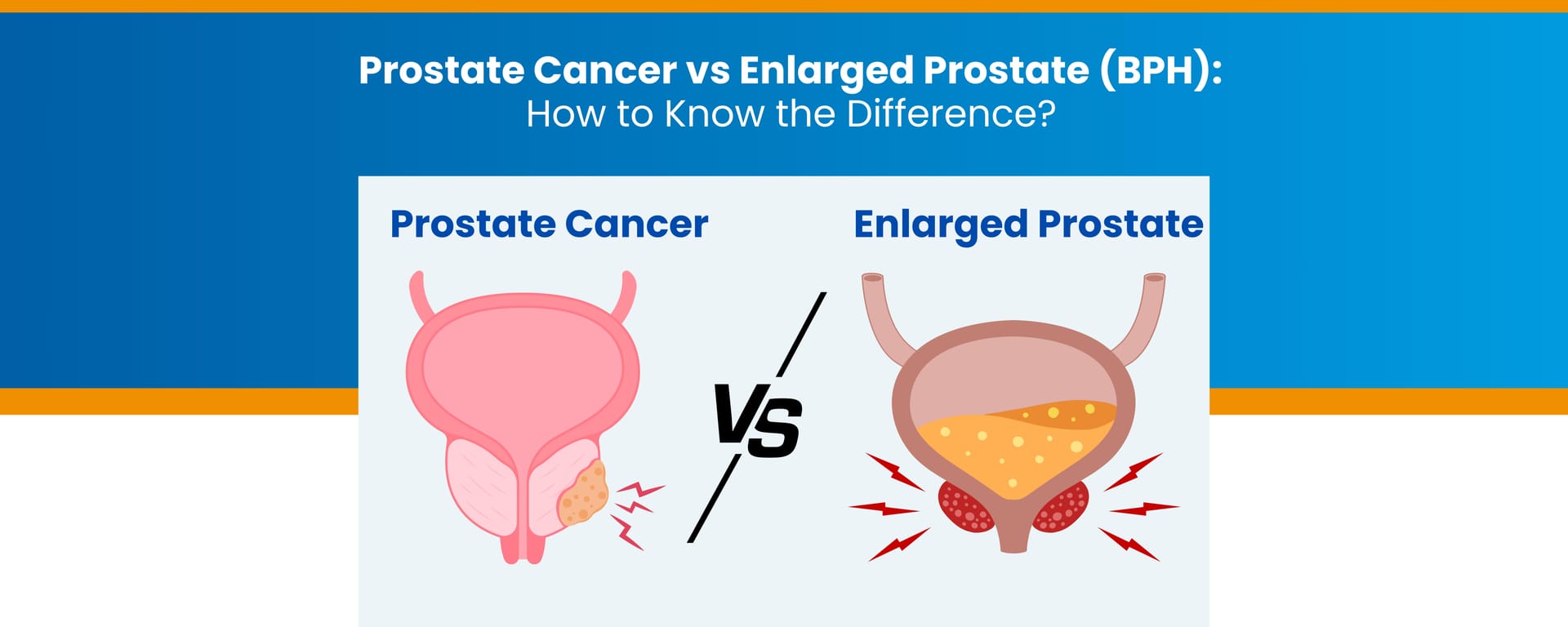
As men age, one common health concern is prostate-related problems. The two most common prostate problems are prostate enlargement (BPH - Benign Prostate Hyperplasia) and prostate cancer.
Both conditions affect the overall health of the patient and cause urinary problems. But their causes, risks, and treatment options are completely different.
Most men confuse both of these conditions; this is why understanding the difference between an enlarged prostate and prostate cancer is important.
Knowing about your condition helps you make an informed decision and receive timely treatment.
Read on as we uncover the differences between prostate enlargement and prostate cancer.
What Causes Enlarged Prostate (BPH) and Prostate Cancer?
BPH (enlarged Prostate)
This is a non-cancerous (benign) growth of the prostate gland. Usually occurs in men above 50 years of age.
Prostate Cancer
Abnormal and uncontrollable growth of prostate cells, which spreads to surrounding organs if left untreated.
Enlarged Prostate |
Prostate Cancer |
|
Cause |
Grows with age |
GeneticsAgeDietLifestyle |
Risk factors |
AgeFamily historyObesitySedentary lifestyleHormonal changes |
AgeFamily historyHigh-fat dietSmoking |
BPH cannot increase the risk of cancer, but it can cause similar urinary problems. Prostate cancer can spread to the bones, lymph nodes, and surrounding organs.
Enlarged Prostate vs Prostate Cancer: Symptom Comparison
The symptoms of an enlarged prostate and prostate cancer can be similar as they involve the urinary tract.
Here is an easy comparison
Symptom |
Enlarged Prostate (BPH) |
Prostate Cancer |
Frequent urination, especially at night |
Common symptom |
It can occur rarely |
Weak urine stream |
Very common |
It is possible, but not common |
Trouble starting urination |
Common |
Occasional |
Cannot empty bladder |
Common |
Occasional |
Blood in urine |
Very rare |
More likely to occur |
Blood in semen |
Uncommon |
Common in advanced cases |
Pelvic pain |
Very rare |
Common in advanced cases |
Erectile dysfunction |
Uncommon |
May occur |
Weight loss |
No |
Yes |
Fatigue |
No |
Yes |
It is important to note that BPH causes discomfort, while prostate cancer is life-threatening if not diagnosed early. Visit NU Hospitals to get tested.
How Are Enlarged Prostates and Prostate Cancer Treated?
Enlarged Prostate treatment options:
-
Medication
Alpha blockers
5 alpha-reductase inhibitors
-
Lifestyle Changes
Reduce alcohol
Drinking fluids at night
-
Minimally invasive procedures
TURP
Enucleation of prostate (HOLEP or Bipolar)
-
Open Surgery
Prostate cancer treatment options:
-
Active surveillance
For the low-grade cancer
-
Surgery
Radical or partial prostatectomy (Open, Laparoscopic, or Robotic)
-
Chemotherapy
-
Immunotherapy
-
Radiation therapy
-
Hormone therapy
Types of Treatment Options for Enlarged Prostate and Prostate Cancer
Treatment |
Enlarged Prostate |
Prostate Cancer |
Lifestyle modification |
Yes |
It can support the main treatment |
Medication |
Alpha blocker5-ARI |
Hormone therapy |
Minimally invasive procedures |
TURPHoLEP |
Radical and partial prostatectomy (robotic) |
Radiation therapy |
Not used |
It is a common treatment option |
Chemotherapy |
Not used |
For advanced cancer |
Immunotherapy |
Not used |
For advanced cancer |
Who Is at Higher Risk for BPH or Prostate Cancer?
BPH
-
Men above the age of 50
-
Men with a family history of an enlarged prostate
-
Obese men
-
Sedentary lifestyle
-
Men with chronic health conditions like diabetes and heart disease.
Prostate Cancer
-
Men over the age of 65
-
Family history of prostate cancer
-
African and Asian men
-
A diet containing red meat and processed food
-
Smoking
-
Alcohol consumption
Make sure you get an annual checkup for prostate issues after the age of 50 or 45 if there is a family history. This helps in early detection, ensuring timely treatment
Why Choose NU Hospitals Bengaluru for the Best Prostate Treatment?
-
No. 1 Hospital for Prostate Care In India and Bangalore
-
Pioneers in Prostate-related Surgery
-
Legacy of Innovation and Trusted by Millions
-
Protocolized Evidence-based Care
-
Renowned Team of Experts in Urology and Uro-oncology with a Multi-Disciplinary Approach
-
Exceptional Care and World-class Technology (Robotic and laparoscopic techniques)







