 Nephrology
 Urology
 Andrology
 Fertility (IVF)
 General Nephrology
 Paediatric Nephrology
 Dialysis
 Renal (Kidney) Biopsy
 CRRT
 Peritonial Dialysis
 Robotic Surgery
 Urinary Incontinence
 Uro-Oncology
 Laparoscopic Urology
 Reconstructive Urology
 Anaesthesiology
 Radiodiagnosis
 Nutrition and Dietetics
 Pediatric and Immunization
 Cardiology
 Intensive Care Unit





If you are looking for safer urology surgeries and expect to be back on your feet soon, robotic surgery is the best choice. It is a common fear of surgery to be worried about blood loss and long recovery days.
Modern urology offers better options with more patient-centric approaches. Robotic surgeries are revolutionising urological treatments. Complex cases can now be treated with more precision and faster recovery.
You might be wondering if the robot does the entire surgery. No, the surgeon handles the robot’s arms through a console. Advanced robotic systems are there to aid the surgeon’s precision with better vision.
Patients get the advantage of faster recovery with robotic surgeries.
How Robotic Urology Surgery Helps?
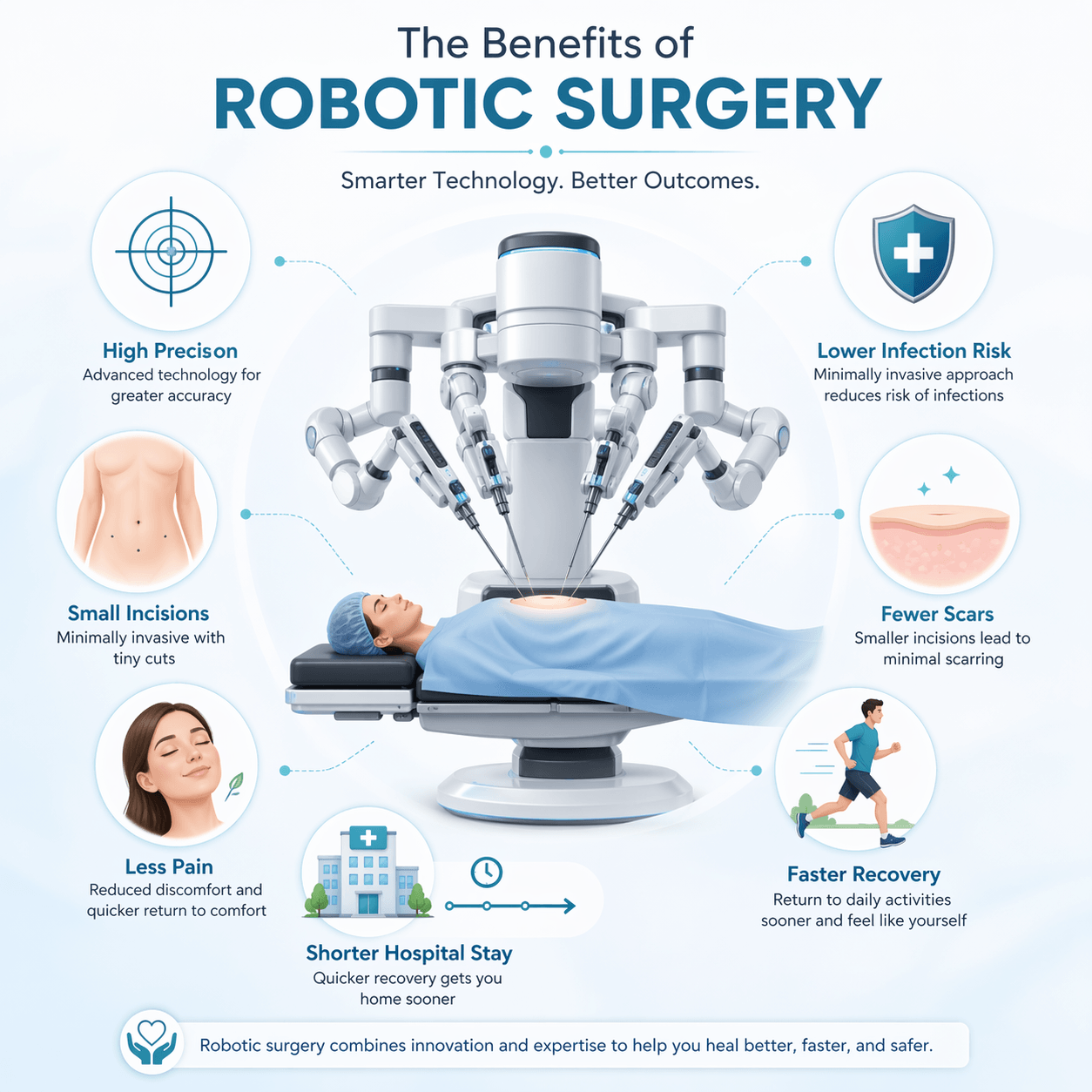
Robotic surgeries offer many benefits, like:
-
High precision
-
Small cuts/incisions
-
Less pain
-
Lesser risk of infections
-
Fewer scars
-
Less hospital stay
-
Faster recovery
Common Types of Robotic Urology Surgeries
Robotic surgery can be performed for various urological conditions. Here are a few common robotic urology surgeries.
Robotic Prostatectomy
Removal of the prostate. Used to treat prostate cancer.
Robotic Nephrectomy
Kidney removal (partial or radical)
Robotic Pyeloplasty
Ureteropelvic junction obstruction repair surgery
Robotic Cystectomy
Bladder removal (partial or radical)
Robotic Ureteral Reimplantation or Reconstruction
Ureteral stricture or damage repair
How Long Does Recovery Take After Robotic Urologic Surgery?
Recovery is faster with robotic surgeries. Let us understand what your recovery timeline looks like with different surgeries.
Surgery |
Hospital stay |
Return to work |
Full recovery |
Robotic Prostatectomy |
4-5days |
2-4 weeks |
6-8 weeks |
Robotic Nephrectomy |
1-2 days |
2-3 weeks |
6-8 weeks |
Robotic Pyeloplasty |
1-3 days |
2-3 weeks |
4-5 weeks |
Robotic Cystectomy |
2-7 days |
3-5 weeks |
6-10 weeks |
Robotic Ureteral Surgery |
1-3 days |
3-4 weeks |
6-8 weeks |
You could potentially be discharged in 24 hours after a robotic surgery; most robotic surgeries allow you to return to your daily life within a short period, when compared to open surgery.
Comparison: Laser vs Laparoscopic vs Robotic Urologic Surgery
Feature |
Laser surgery |
Laparoscopic surgery |
Robotic surgery |
Precision |
High |
Moderate |
Highest |
Visualisation |
Good |
Moderate |
3d Visualisation |
Incisions/invasion |
Small |
Minimal/keyhole |
Minimal |
Pain |
Mild |
Mild |
Least |
Recovery Time |
1-2 weeks |
3-6 weeks |
2-4 weeks |
Conditions treated |
|
General urological surgeries |
|
Even though laparoscopic surgeries are effective, robotic surgeries are much better and superior as they provide effective outcomes for complex urological conditions.
Post-Operative Care Tips After Robotic Urological Surgery for a Faster Recovery
Following all your post-operative instructions will help you with a better and faster recovery.
Recovery Guidelines:
-
Hospital stay
Take all prescribed medications and rest well
-
Walking
Resume walking and light movements within 12-24 hours. This helps to prevent blood clots.
-
You shall be on oral medications for pain management
-
For bladder surgery or prostatectomy, a catheter might be placed temporarily to drain urine.
-
Follow the prescribed diet
-
Maintain hygiene
Tips for Faster Recovery at Home
Once you are discharged from the hospital, follow these simple care tips for faster recovery:
-
Medications
- Follow your prescribed meds.
- Painkillers and antibiotics should be taken on time
- Avoid self-medicating
-
Incision care
- Keep the surgical area clean and dry
- Watch out for warning signs like redness, pus, or swelling
- Consult with your urologist if you notice any of these signs
-
Hydration
- Drink an adequate amount of water as advised by your doctor.
-
Diet
- Make sure your diet is fibre-rich
- Have a balanced meal
- Avoid high salt intake
- Avoid processed food
- Avoid soft drinks
-
Gentle movement
- Start walking small distances a couple of times a day
- Avoid heavy lifting until cleared by the doctor
-
Bowel care
- Constipation can affect wound healing; following the right diet and being hydrated can help with good bowel movements.
-
Gradual resumption of physical activity
- You can resume light exercises and activities after 2 weeks
- You can drive after a week or two (depending on the type of surgery)
- Full-fledged exercises can be resumed post 6 weeks when your doctor clears you for the same.
When Can You Resume Normal Activities after Urological Robotic Surgery?
Activity |
Duration |
Work (desk job) |
2-4 weeks |
Work (strenuous labour) |
3-6 weeks or after full recovery |
Driving |
1-2 weeks |
Exercise (walking) |
12-24 hours |
Exercise (light workout) |
2-3 weeks |
Exercise (heavy workout) |
6-8 weeks |
Sexual activities |
6-8 weeks (longer for prostatectomy patients) |
When Should You Contact Your Urologist After Robotic Surgery?
If you notice any of the following, consult with our expert immediately:
-
Severe pain which is not eased even with medication
-
High fever
-
Persistent nausea and vomiting
-
Heavy blood in urine
-
Swelling of the surgical site
-
Pus, foul smell, or unknown discharge from the surgical site
-
Unable to urinate
-
Urine leakage








