 Nephrology
 Urology
 Andrology
 Fertility (IVF)
 General Nephrology
 Paediatric Nephrology
 Dialysis
 Renal (Kidney) Biopsy
 CRRT
 Peritonial Dialysis
 Robotic Surgery
 Urinary Incontinence
 Uro-Oncology
 Laparoscopic Urology
 Reconstructive Urology
 Anaesthesiology
 Radiodiagnosis
 Nutrition and Dietetics
 Pediatric and Immunization
 Cardiology
 Intensive Care Unit




Are you struggling to urinate? Are you sitting in the washroom, unable to urinate?
Several people deal with this condition every day. You feel the urge; however, you are unable to urinate. And even if you do urinate, you still feel like your bladder is not empty. It can be quite uncomfortable and frustrating.
Most people feel embarrassed to talk about their condition. However, difficulty in urinating is not a condition that you should ignore. It may be a sign of underactive bladder, prostate enlargement, nerve problems, or other urinary conditions.
Your bladder is supposed to squeeze and empty smoothly. When the squeezing becomes weak, urine stays inside. Over time, this can lead to infections, bladder stretching, and even kidney problems.
At NU Hospitals, Bengaluru, our experienced urologists specialize in diagnosing and treating such bladder conditions. With advanced tests such as ultrasound, uroflowmetry, and urodynamic studies, our doctors find the exact cause of your symptoms.
Your treatment may include simple bladder training, medications, prostate management, or guided self-catheterization if needed. Every treatment is personalized according to your condition.
If you want to learn more about underactive bladder and its treatment, read this blog.
What Is an Underactive Bladder?
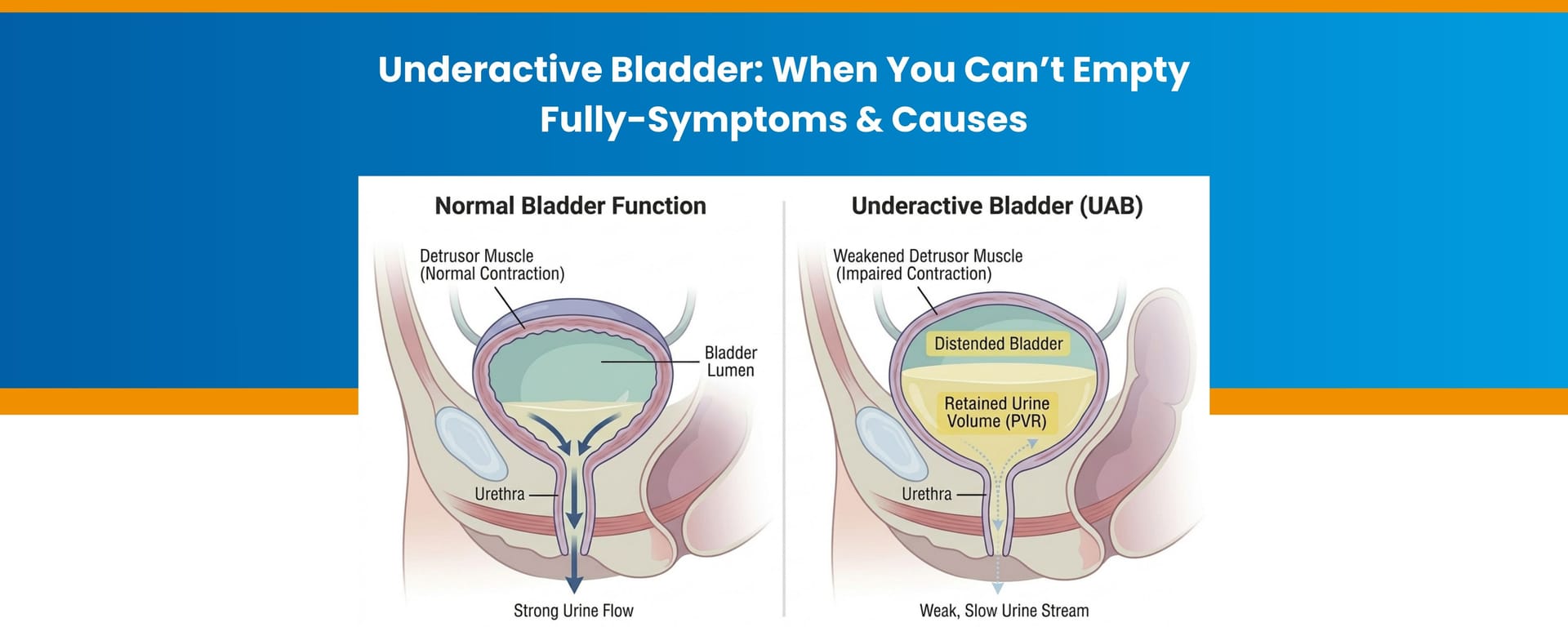
An underactive bladder is a condition where your bladder muscle does not contract strongly to empty urine.
Meaning of Poor Bladder Emptying
It means urine stays behind in your bladder after you think you have emptied. This leftover urine is called residual urine.
You may have a heavy, bloated feeling in your lower abdomen.
How Underactive Bladder Differs from Overactive Bladder
Feature |
Overactive Bladder (OAB) |
Underactive Bladder (UAB) |
Primary Issue |
The bladder squeezes too often/suddenly when you have no intent to pass urine. |
The bladder does not squeeze hard enough when you are trying to pass urine. |
Urge |
Sudden, intense urge to urinate. |
No urge to urinate. |
Stream |
Usually normal but frequent. |
Weak, slow, or hesitating. |
Emptying |
Usually empties fully. |
Unable to empty completely. |
Is Underactive Bladder a Disease or a Symptom?
An underactive bladder is a clinical symptom syndrome. It is usually a sign that something else, such as your nerves or the bladder muscle itself, is not working properly.
Common Symptoms of an Underactive Bladder
Recognizing the symptoms of an underactive bladder is the first step to getting relief. It is about how the process feels.
Feeling of Incomplete Bladder Emptying
-
Constant sensation of leftover urine
-
Need to return to the toilet quickly
-
Discomfort in your lower abdomen
This is the most common complaint.
Weak or Slow Urine Stream
-
Urine flow is very slow
-
Takes longer than usual to urinate
-
Stops and starts
If your stream is weaker than usual, then do not ignore it.
Straining to Pass Urine
-
You push or strain
-
You wait for your urine to begin
-
You feel pressure while urinating
This usually signals bladder muscle weakness.
Frequent Urinary Tract Infections
With residual urine in your bladder, chances of infection increases.
-
Burning sensation
-
Fever
-
Cloudy urine
-
Recurrent infections
Repeated infections are a red flag in underactive bladder diagnosis.
Overflow Incontinence or Dribbling
When your bladder becomes too full:
-
Urine leaks unexpectedly and large amounts of still remains in the bladder
-
Dribbling towards end of urination
-
Wetness without warning
What Causes an Underactive Bladder?
Understanding the causes of an underactive bladder helps in planning the right treatment for you.
Nerve Damage (Diabetes, Spine, or Stroke)
Bladder function depends on your nerves.
Conditions such as diabetes, spinal cord injury, and stroke can damage your bladder nerves. Without proper nerve signals, your bladder will not contract well.
Bladder Muscle Weakness
The bladder muscle may weaken due to aging, long-term stretching, and chronic retention. Weak muscle leads to weak contraction of your bladder.
Prostate Enlargement in Men
In men, an enlarged prostate can block the flow of urine. Therefore, your bladder works harder over time. Eventually, it becomes tired and weak.
This is common in older men with long-standing prostate conditions.
Long-Term Catheter Use or Bladder Overstretching
If your bladder remains stretched for a long period of time:
-
Your bladder muscle loses strength
-
The sensation reduces
-
Emptying becomes incomplete
Side Effects of Certain Medications
Some medicines, such as anticholinergic drugs, a few antidepressants, and sedatives, can reduce your bladder contraction.
Your doctor may review medications during an underactive bladder diagnosis.
Who is at Risk of Developing an Underactive Bladder?
Not everyone gets an underactive bladder. However, a certain group of people is more prone to it.
Older Adults
-
Muscle strength decreases with age
-
Nerve function slows down
-
Bladder sensation also reduces
However, it is not a normal part of aging.
People with Diabetes or Neurological Conditions
Long-term diabetes can damage the nerves controlling the bladder. Neurological conditions can also increase the risk.
Men with Long-Standing Prostate Problems
Chronic obstruction can weaken your bladder muscle over time.
Post-Surgery or Post-Delivery Patients
Pelvic surgery or difficult childbirth may affect your bladder nerves temporarily or permanently.
How Underactive Bladder Is Diagnosed at NU Hospitals, Bangalore
At NU Hospitals, Bengaluru, advanced testing makes sure you get an accurate underactive bladder diagnosis.
Post-Void Residual Urine Test
-
It measures your leftover urine after urinating
-
Done with the help of ultrasound. It is quick and painless.
Large residual urine can confirm there is incomplete emptying.
Ultrasound of Bladder & Kidneys
It helps to check for:
-
Bladder wall thickness
-
Kidney swelling
-
Large residual urine
Uroflowmetry and Urodynamic Studies
These tests measure your:
-
Urine flow speed
-
Bladder pressure
-
Bladder muscle strength
This will confirm an underactive bladder.
Neurological Evaluation (When Needed)
If nerve damage is suspected, our doctors may suggest:
-
Detailed nerve examination
-
Imaging tests like MRI of the Lumbosacral Spine
-
Diabetes evaluation
Treatment Options for Underactive Bladder
There is treatment for an underactive bladder. However, your treatment will depend on the severity and cause of your condition.
Timed Voiding & Bladder Training
Go to the bathroom on a schedule. Do not wait for an urge.
Medications to Improve Bladder Emptying
Some medicines may help your bladder muscle contract better to let urine flow more easily.
Intermittent Self-Catheterization
It is a very common and safe way where you use a tiny catheter to empty your bladder yourself a few times a day.
Treating the Underlying Cause (Prostate, Nerves, Diabetes)
Addressing root causes is a key part of treatment for an underactive bladder.
What Happens If an Underactive Bladder Is Left Untreated?
Ignoring an underactive bladder can lead to serious problems.
-
Recurrent Urinary Infections
-
Bladder Damage & Kidney Problems
-
Impact on Quality of Life
Underactive Bladder Care at NU Hospitals, Bangalore
If you are dealing with an underactive bladder and you are looking for help, visit NU Hospitals. NU Hospitals, Bangalore, is a leading center for urology and nephrology. At NU Hospital,s you get:
-
Expert Urologists & Neuro-Urology Specialists
-
Advanced Diagnostic Facilities
-
Personalized Long-Term Bladder Care Plans








