 Nephrology
 Urology
 Andrology
 Fertility (IVF)
 General Nephrology
 Paediatric Nephrology
 Dialysis
 Renal (Kidney) Biopsy
 CRRT
 Peritonial Dialysis
 Robotic Surgery
 Urinary Incontinence
 Uro-Oncology
 Laparoscopic Urology
 Reconstructive Urology
 Anaesthesiology
 Radiodiagnosis
 Nutrition and Dietetics
 Pediatric and Immunization
 Cardiology
 Intensive Care Unit




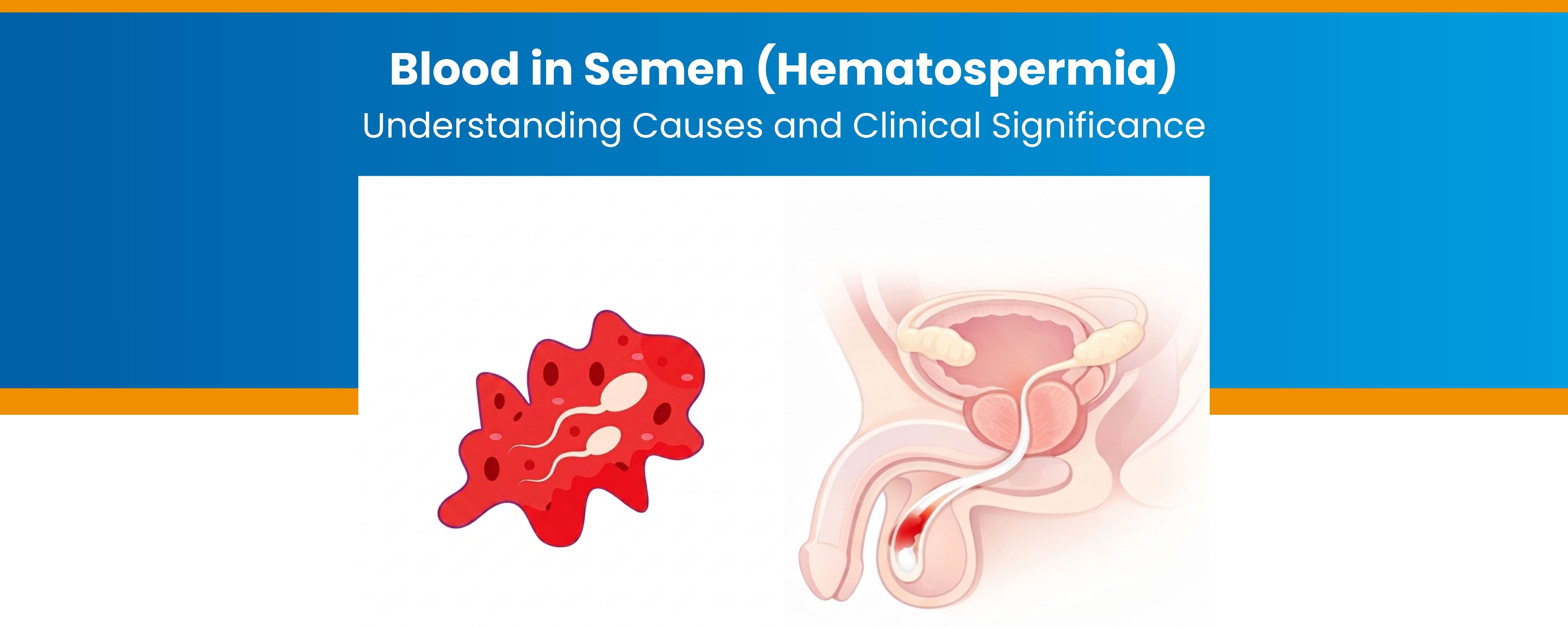
Introduction
The presence of blood in the seminal fluid, also called hematospermia, while not harmful, can cause immense worry for those who experience it frequently. A major cause of hematospermia is the presentation of any form of inflammatory/infectious process in the seminal vesicles, prostate, and prostatic urethra. While hematospermia in younger males can be self-limiting, its occurrence in males over the age of 40 years requires expert evaluation for any significant underlying cause.
Common Causes of Hematospermia
Hematospermia may originate from multiple sites within the male genital tract, particularly from organs responsible for seminal emission, including the prostate gland, seminal vesicles, and ejaculatory ducts. The most common causes include infection, inflammation, trauma, and instrumentation. In a few instances, the condition may be related to a systemic medical disease. No treatment is indicated without determining the cause, since it depends on the underlying condition and not the symptom per se.
Inflammatory and Infectious Causes
Infections and inflammatory conditions are generally the major causes of blood in semen. Some of the major ones include:
-
Prostatitis
-
Seminal vesiculitis
-
Sexually transmitted infections
Trauma and Iatrogenic Causes
Another major contributing factor to blood in semen is any sort of trauma or surgery in recent times. Iatrogenic causes are also prominent. Some of these include:
-
Prostate biopsy
-
Urethral instrumentation
-
Vigorous sexual activity
Systemic Conditions
Several systemic conditions are equally responsible for conditions like blood in semen. Some of them include:
-
Hypertension
-
Bleeding disorders
-
Liver disease
Is Blood in semen a Sign of Cancer?
In the vast majority of instances, hematospermia is not related to cancer. There is, however, the rare possibility of a relationship to prostate cancer, tumour of the seminal vesicles, or vascular abnormalities. The proper evaluation serves to allay fear of serious illness if the findings are benign. In the overwhelming majority, cancer is not related to hematospermia. In men over 40 years, with symptoms of hematospermia, evaluation is needed to rule out conditions like:
-
Prostate cancer
-
Tumours of the seminal vesicles
-
Vascular abnormalities: Arteriovenous malformations
Diagnostic Evaluation
The diagnostic approach for hematospermia mainly begins with a detailed history and physical examination. Thus, physicians evaluate associated symptoms in light of the sexual history, the procedure performed recently, and systemic illnesses. Urine analysis and urine culture help diagnose infection. PSA testing can be advised for older males. TRUS (Transrectal Ultrasound) provides imaging of the prostate and seminal vesicles for structural abnormalities or inflammation.
Assessment options generally include:
-
History and examination of details
-
Urine Analysis and Culture
-
PSA Testing, TRUS (Transrectal Ultrasound) to view the prostate and seminal vesicles
Differential Diagnosis
The table clearly explains the differential diagnosis through common and rare causes of Hematospermia.
Common Causes |
Rare Causes |
Infection |
Prostate cancer |
Prostatitis |
Arteriovenous malformations |
Trauma |
Bleeding disorders |
When to Worry: Red Flags
Blood in semen is not a common occurrence. Therefore, early intervention and identifying red flags on time are of utmost importance to avoid any serious diseases. The table below outlines the red flags patients should not ignore.
Feature |
Clinical Concern |
Age more than 40 |
Requires evaluation |
Persistent episodes |
Further testing needed |
Painful ejaculation |
Suggests inflammation |
Urinary symptoms |
Prostate involvement |
Treatment and Management
Treatment depends entirely upon the cause of the problem. For infections, antibiotics are the treatment of choice, while inflammation can be treated with anti-inflammatory drugs. Quite often, the problem spontaneously resolves, and no treatment is required. The prognosis is quite good, so long as proper care is administered.
Specific treatments usually depend on determining the actual cause of the condition. Some of the treatment options generally preferred include:
-
Infection antibiotics
-
Anti-inflammatory therapy
-
Reassurance for Self-limiting Cases
-
Targeted Intervention for Structural Abnormalities
Most of these are completely resolved with appropriate management.
NU Hospitals - Men’s Diagnostic Excellence
The NU Hospitals offer a Comprehensive Men’s Health Diagnostic Package. This focuses on investigating patients with hematospermia, which is done accurately and efficiently with the latest technology. The diagnostic services provided by NU Hospitals are termed the Men's Health Diagnostic Suite. This ensures the diagnosis of benign health conditions through HR tests, TRUS (Transrectal Ultrasound) procedures, PSA testing, and urological examinations, while eliminating the presence of dangerous disease processes.
Therefore, this systematic approach is all about accurately diagnosing benign disease and carefully excluding all serious pathologies. This is all done in a very timely manner.








