 Nephrology
 Urology
 Andrology
 Fertility (IVF)
 General Nephrology
 Paediatric Nephrology
 Dialysis
 Renal (Kidney) Biopsy
 CRRT
 Peritonial Dialysis
 Robotic Surgery
 Urinary Incontinence
 Uro-Oncology
 Laparoscopic Urology
 Reconstructive Urology
 Anaesthesiology
 Radiodiagnosis
 Nutrition and Dietetics
 Pediatric and Immunization
 Cardiology
 Intensive Care Unit




Overview
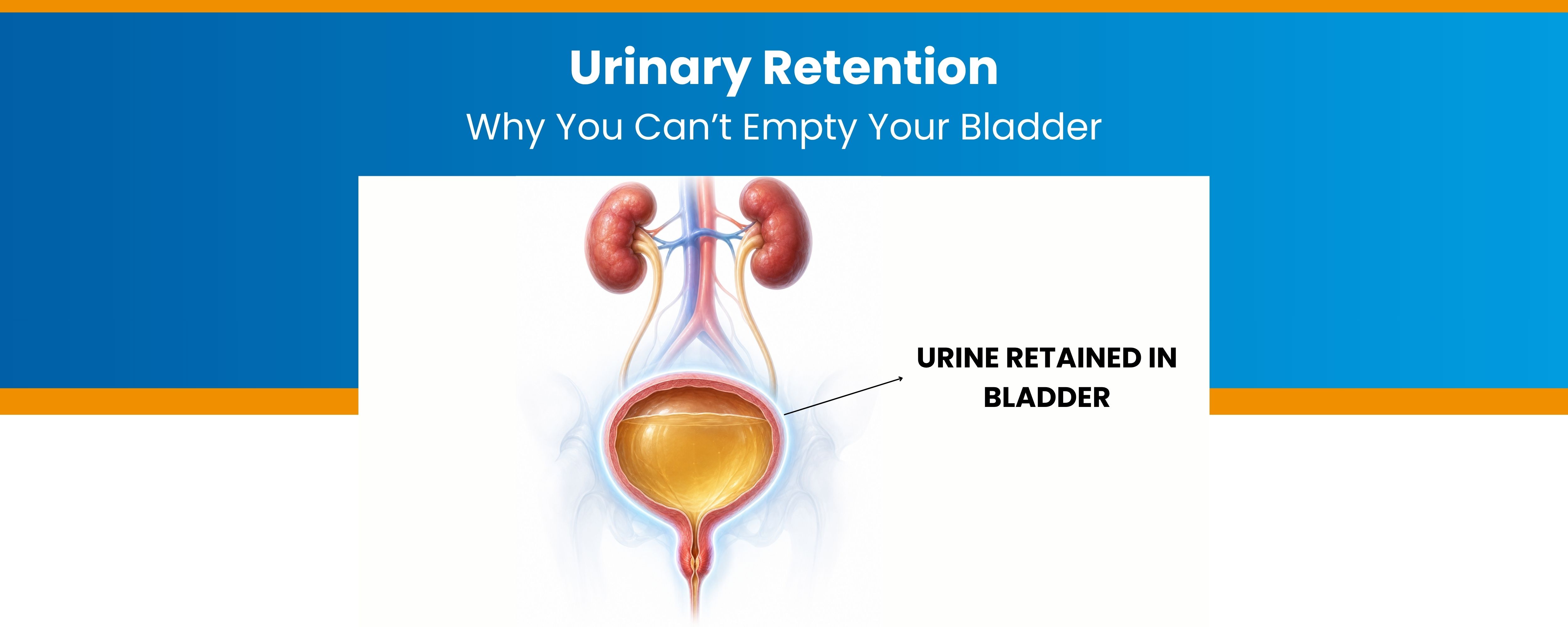
Urinary retention is a distressing and sometimes painful condition in which the bladder is unable to empty itself completely or at all. While anyone can be affected by urinary retention, it is more commonly seen in men over 60 years of age. Women can get acute urinary retention, but it is much less common. Urinary retention might be caused by bladder outlet obstruction or nerve-related dysfunction. The condition warrants prompt medical evaluation to avoid further complications. It is important to understand the causes, symptoms, and complications of urinary retention to avoid long-term kidney damage and maintain quality of life.
What Is Urinary Retention?
Urinary retention is a specific medical condition in which your bladder does not empty properly during urination. In some cases, the bladder may not empty at all. We all know that the urinary bladder stores urine, which is made up of the waste filtered by the kidneys. Under normal circumstances, the brain signals the bladder muscle to contract while the urinary sphincters relax, allowing urine to pass. Urinary retention occurs when this highly coordinated process is disrupted.
Urinary retention can be of two types:
-
Acute Urinary Retention: This is a sudden, painful inability to pass urine and requires immediate medical attention. Common in older men, prostate enlargement may be a cause of acute urinary retention.
-
Chronic Urinary Retention: In chronic urinary retention, affected patients experience a long-term inability to fully empty the bladder. While they may still pass some urine, they leave a post-void residual behind.
Urinary Retention Causes: What Is Blocking Your Bladder From Emptying?
Causes of urinary retention can vary from person to person. The reasons can range from a blockage in the free flow of urine to previous surgeries. Urinary retention causes include:
-
Blockage: Prostate enlargement, bladder outlet obstruction affecting the neck of the bladder, urethral obstruction (urethral stones, blood clots, tumours, etc.), or conditions such as cystocele and rectocele can block the free flow of urine through the bladder and urethra. Blockage may also occur when the urethra narrows due to scar tissue (urethral stricture).
-
Nerve Issues: We have learned that the brain plays an important role in the process of urination. However, when a person is affected by stroke, diabetes, multiple sclerosis, spine/pelvis trauma, and more, nerve issues can cause urinary retention. Vaginal childbirth or pressure on the spinal cord from tumours can also result in these nerve issues.
-
Medication: Some medications, like antihistamines, antispasmodics, opiates, and antidepressants, can affect bladder function, causing urinary retention (precipitating causes).
-
Infection: Urinary retention can be caused by some infections like acute prostatitis or prostatic abscess.
-
Surgery: Lastly, hernia or piles surgery, and hip joint replacement surgeries can also cause urinary retention. Moreover, general anaesthesia during the procedures may also result in temporary issues with how you urinate.
Category |
Cause |
More Common In |
Prostate-Related |
Prostate enlargement |
Men over 50 |
Prostate cancer |
Men over 45 |
|
Prostatitis |
Adult men |
|
Structural/Obstructive |
Urethral stricture (scar tissue narrowing) |
Adult men |
Bladder neck contracture |
Post-surgical patients |
|
Bladder stones/tumours |
Both sexes |
|
Cystocele |
Women |
|
Pelvic organ prolapse |
Women |
|
Neurological |
Spinal cord injury/compression |
Both sexes |
Multiple sclerosis |
Both sexes |
|
Parkinson’s disease |
Both sexes |
|
Diabetic neuropathy |
Both sexes |
|
Stroke |
Both sexes |
|
Medication |
Anticholinergics, antihistamines |
Both sexes |
Opioids, antidepressants, decongestants |
Both sexes |
|
Post-Surgical |
Anaesthesia effects, joint replacement surgery. |
Both sexes |
Infection/Inflammation |
UTI, STIs, etc. |
Both sexes |
Psychological |
Fowler’s syndrome, psychogenic retention |
Predominantly women |
Enlarged Prostate and Its Role in Urinary Retention
Clinically known as Benign Prostatic Hyperplasia (BPH), prostate enlargement is one of the most common urinary retention causes in men. As the prostate continues to grow, it compresses the urethra, thereby restricting normal urine flow.
Symptoms of an enlarged prostate include:
-
Frequent or urgent need to urinate.
-
Trouble starting to urinate.
-
Poor urine stream.
-
Inability to completely empty the bladder.
-
Urinary tract infection.
-
Inability to urinate at all.
-
Haematuria: Presence of blood in the urine
-
Nocturia: Urinating more often at night.
Urinary Blockage Symptoms to Watch Out For
How does one know if they are suffering from urinary retention? Recognising urinary blockage symptoms early on can prevent a trip to the emergency room. Said symptoms can vary from person to person, depending on whether your condition is acute or chronic.
In the case of acute urinary retention, the symptoms include:
-
An inability to urinate.
-
Severe pain in the lower abdomen.
-
Urgent need to urinate.
-
Swelling in the lower abdomen.
As for chronic urinary retention, which builds up over time, the symptoms are:
-
Inability to completely empty the bladder.
-
Increased frequency of urination, but in small amounts.
-
Weak urine stream.
-
Urgency to urinate with little or no results.
-
Leaking urine.
-
Pain or discomfort in the lower abdomen.
Difficulty Urinating: When to See a Doctor?
Urination is the primary means of removing waste from the body, and the inability to do so should not be considered a minor inconvenience. You should seek medical assistance immediately if you notice one or more of the following symptoms:
-
A complete inability to urinate.
-
Sudden and severe pain in the lower abdomen with a full bladder.
-
Presence of blood in your urine.
-
Fever.
-
Symptoms that occur after a spinal injury, surgery, or a new medication.
Urinary blockage symptoms that persist for even a few hours can damage the kidneys; thus, timely evaluation is critical for complete recovery.
Treatment for Urinary Retention
Once urinary retention has been diagnosed through physical examination and other tests, your healthcare provider will discuss the best course of action. Treatment depends on whether the condition is acute or chronic urinary retention.
Catheterisation is required in acute retention and it gives immediate relief from pain. Types of catheterisation include:
-
Urethral: This is inserted into the bladder via the urethra to drain urine.
-
Suprapubic: A catheter is inserted through the lower abdomen directly into the bladder. This may only be done when urethral catheterisation is not possible (like in strciture urethra).
In men in retention of urine due to prostate, after catheterisation, your Urologist will mostly examine the prostate by rectal examination and start treatment for prostate enlargement:
-
Alpha blockers alone or along with Dutasteride.
-
And give a trial void after 3 days (if there are no other contraindications)
In Chronic retention: There is no hurry to catheterize. This condition needs detailed evaluation, including Urine analysis, urine culture, Ultrasound study, uroflowmetry, and sometimes urodynamics to know the cause of large residual urine.
NU Hospital’s Approach
The diagnosis of conditions like urinary retention goes beyond basic imaging at NU Hospitals. In our urology department, we utilise advanced diagnostic techniques, such as flexible cystoscopy, a minimally invasive procedure that enables our specialists to visually inspect the urethra, prostate, bladder neck, and bladder.
NU Hospitals is dedicated to providing patients with a comprehensive workup to determine the exact cause and extent of the retention, ensuring the process is both efficient and effective.
Conclusion
Regardless of whether it is acute or chronic in nature, urinary retention is a significant risk to your body’s health. It calls for urgent medical attention, not patience. There are a multitude of urinary retention causes, ranging from prostate enlargement to urinary bladder obstruction. It is important that we recognise the symptoms of urinary blockage so we can address the condition accordingly.








