 Nephrology
 Urology
 Andrology
 Fertility (IVF)
 General Nephrology
 Paediatric Nephrology
 Dialysis
 Renal (Kidney) Biopsy
 CRRT
 Peritonial Dialysis
 Robotic Surgery
 Urinary Incontinence
 Uro-Oncology
 Laparoscopic Urology
 Reconstructive Urology
 Anaesthesiology
 Radiodiagnosis
 Nutrition and Dietetics
 Pediatric and Immunization
 Cardiology
 Intensive Care Unit




Overview
A severe and persistent flank ache, difficulty urinating, or recurring infections may be vague symptoms pointing to something more serious. Patients often visit urology clinics with these complaints, only to find an underlying urinary obstruction that has been silently damaging their kidneys.
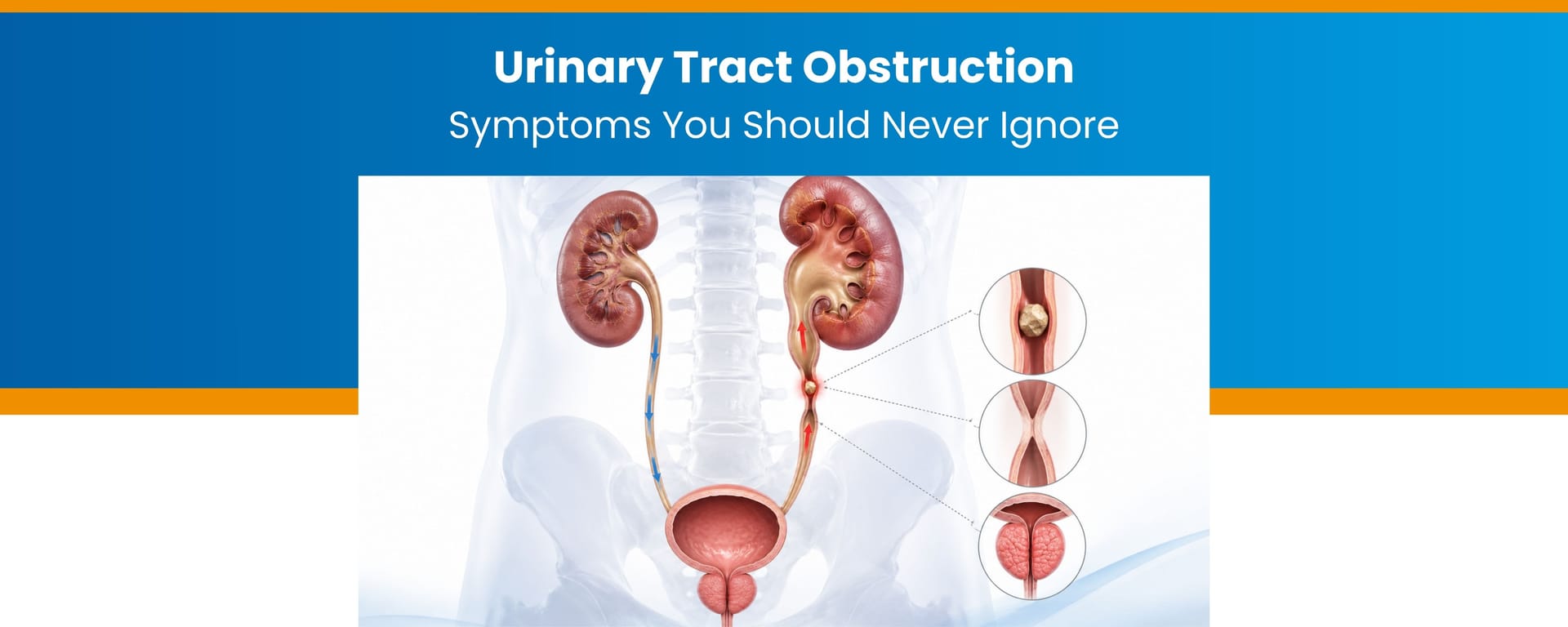
Urinary Tract Obstruction, or urinary blockage, is the impairment of the normal urine flow through the urinary tract, which includes the ureters, kidneys, bladder, and urethra. Blocked urine flow can cause urine to back up, increasing the pressure within the kidneys and triggering a condition known as Hydronephrosis. It may also cause kidney damage if left untreated for a long time. Once you notice common urinary obstruction symptoms, make sure to get them checked out for early diagnosis, which can lead to better outcomes.
What Is Urinary Tract Obstruction?
Urinary tract obstruction refers to any blockage in the urinary tract that prevents the free flow of urine. Since the urinary tract includes the kidneys, ureters, bladder, and urethra, obstructions can occur at any level. This urinary blockage can either be partial or complete, and may contribute to complications such as kidney stones, infection, or further damage.
In a normal scenario, the urine flows out of the kidneys at a low pressure. However, in the event of a blockage, urine begins to back up and reach the renal pelvis. The renal pelvis is a funnel-shaped structure located at the centre of the kidney, where urine is collected and channelled into the ureters. This leads to swelling in the kidney as well as increased pressure within the kidney. The condition is known as hydronephrosis.
Urinary blockage can occur at multiple anatomical points:
-
Upper Tract: renal pelvis, ureteropelvic junction (UPJ), ureters.
-
Lower Tract: bladder outlet, urethra, or other surrounding structures.
Blocked urine flow has multiple complications, but it depends on whether the blockage is unilateral or bilateral and how quickly it develops. Unilateral blockage occurs when the obstruction is in a single kidney, while bilateral blockage occurs when the obstruction affects both kidneys.
Urinary Obstruction Symptoms
Urinary obstruction is not a condition one can afford to ignore, making it important to recognise its warning signs. Some common urinary obstruction symptoms include:
-
Frequent urination.
-
Difficulty urinating.
-
Decreased urine volume.
-
Cloudy urine.
-
Foul-smelling urine.
-
Involuntary loss of urine or urinary incontinence.
-
Hematuria: Presence of blood in the urine.
-
Swelling in the feet, legs, or lower abdomen.
-
Fever accompanied by chills.
-
Nausea.
-
Vomiting.
-
Lower abdominal or back pain.
-
Inability to empty the bladder completely or urinary retention.
Urinary Obstruction Causes
There are numerous causes of urinary obstruction, including:
-
Structural Abnormalities: Birth defects that narrow or block the ureters or the urethra.
-
Kidney Stones: Small mineral deposits that develop in the kidneys. While they usually pass in the urine, larger stones may need to be removed.
-
Bladder Stones: Just like kidney stones, hard mineral deposits can form in the bladder, causing urinary blockage if large in size. They can also move into the urethra.
-
Benign Prostatic Hyperplasia (BPH): A noncancerous enlargement of the prostate gland, common in men over the age of 50.
-
Tumours: Tumours in the kidneys, ureters, bladder, or urethra may block the normal flow of urine. These tumours can either be cancerous or noncancerous.
-
Clots: Blood clots in the urinary tract can cause urinary obstruction. They are more common in people with blood-clotting disorders or those who have undergone surgery recently.
-
Others: Other causes of urinary obstruction include medications, radiation therapy, pregnancy, blood vessel abnormalities, and more.
Cause |
Location |
Onset |
Severity |
Key Symptom |
Treatment Urgency |
Kidney/ureteral stone |
Ureter or UPJ |
Acute |
Moderate-severe |
Severe pain |
Urgent |
UPJ obstruction |
Kidney pelvis |
Gradual/congenital |
Moderate |
Flank pain, hydronephrosis |
Elective-Urgent |
BPH |
Bladder outlet |
Gradual |
Mild-severe |
Weak stream, urinary retention |
Elective-Urgent |
Ureteral stricture |
Ureter |
Gradual |
Moderate |
Recurrent UTI, flank pain |
Elective |
Pelvic malignancy |
Ureter/bladder |
Gradual |
Severe |
Hematuria |
Urgent-Emergency |
Retroperitoneal fibrosis |
Bilateral ureters |
Gradual |
Severe |
Silent renal failure |
Urgent |
Congenital anomaly |
Variable |
Congenital |
Variable |
Detected on imaging |
Elective |
Hydronephrosis: Symptoms and Causes
When one or both kidneys swell, the condition is known as hydronephrosis. Hydronephrosis occurs when an obstruction prevents urine from flowing from the kidney to the bladder, causing swelling of the kidney. The condition can take multiple forms depending on whether the swelling is chronic, sudden, or partial. Swelling can be mild or severe, and hydronephrosis may lead to the loss of kidney function or complete kidney failure.
Symptoms of hydronephrosis include:
-
Painful urination.
-
Haematuria.
-
Urinary tract infection (UTI).
-
Nausea.
-
Vomiting.
-
Sudden pain in the sides, back, or abdomen.
-
Inability to completely empty your bladder.
-
Increased or decreased urine volume.
The most common cause of hydronephrosis is a urinary tract obstruction in one or more parts of the urinary tract. Hydronephrosis causes include:
Diagnosing and Treating Urinary Obstructions
Early diagnosis is important for urinary blockage, as it can be corrected before it leads to irreversible kidney damage. Doctors may use one of the following methods to diagnose urinary obstructions:
-
Catheterisation: A hollow and soft instrument is inserted into the bladder through the urethra. Before bladder catheterisation, doctors typically use ultrasonography to determine whether the bladder contains urine.
-
Imaging: Various imaging techniques, such as CT scans, MRI, and VCUG, can be used to diagnose and locate the blockage.
-
Blood Tests: In cases where the obstruction has completely blocked both kidneys, blood test results may indicate elevated levels of BUN, Creatinine, or both; however, if the blockage is incomplete or acute, the blood tests would return normal results.
-
Urine Test: When there is a stone or a tumour in the urinary tract, WBCs and RBCs may be found in the urine. Elevated RBC or WBC levels may result from infection in the obstructed area.
-
Endoscopy: A flexible endoscope is inserted into the ureters or the kidney to identify the sites of obstruction. This method can also remove the blockage at times.
After a patient has undergone the diagnostic process, the next step is prompt medical intervention. These could include the following treatments:
-
Drugs: Alpha blockers, diuretics, antimuscarinics, alpha reductase inhibitors, and antibiotics may be used to treat various cases of urinary flow obstruction.
-
Surgery: Various surgical interventions may be considered for urinary flow obstruction, including ureteral stenting, nephrostomy, bladder neck incision, endoscopic surgery, urethral dilation, and others.
Discuss with your healthcare provider to figure out which treatment plan works best for you.
The NU Hospitals Approach to Advanced Urology Treatment
Patients with urinary obstructions can benefit from NU Hospitals’ state-of-the-art Robotic Pyeloplasty, a minimally invasive procedure performed with robotic-assisted tools guided by the surgeon. These tools provide the surgeon with a clear view of the area being repaired. On the day of surgery, NU Hospitals ensures swift admission of patients, after which they meet with the nursing and anaesthesia teams. After the procedure, patients spend time recovering and undergo regular follow-ups.
Conclusion
A urinary blockage is more than just a discomfort; it is a direct threat to long-term renal health. Awareness of urinary obstruction symptoms leads to prompt diagnosis and effective treatment, ensuring the patient’s overall well-being. Regardless of the cause, modern urology treatments have evolved to offer solutions that are both effective and minimally invasive. Remember, early diagnosis ensures better outcomes!








