 Nephrology
 Urology
 Andrology
 Fertility (IVF)
 General Nephrology
 Paediatric Nephrology
 Dialysis
 Renal (Kidney) Biopsy
 CRRT
 Peritonial Dialysis
 Robotic Surgery
 Urinary Incontinence
 Uro-Oncology
 Laparoscopic Urology
 Reconstructive Urology
 Anaesthesiology
 Radiodiagnosis
 Nutrition and Dietetics
 Pediatric and Immunization
 Cardiology
 Intensive Care Unit




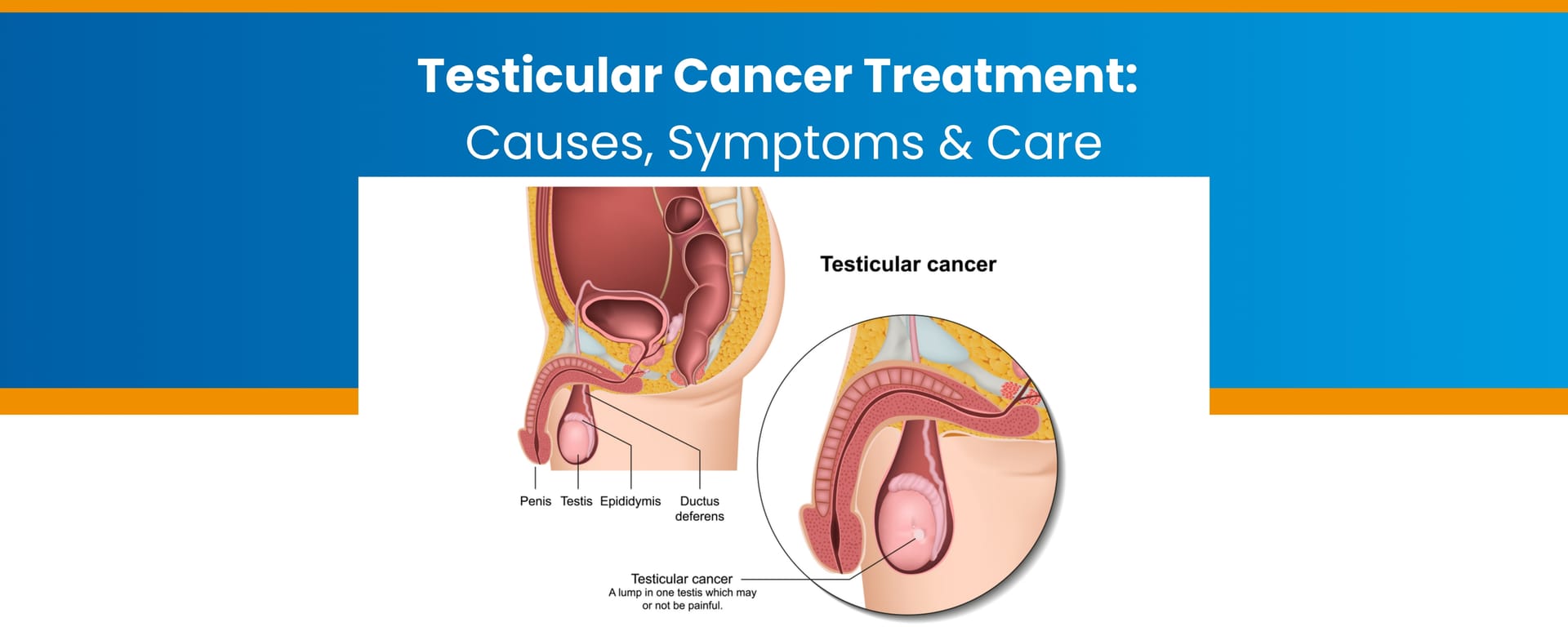
Have you felt a small lump while taking a shower? Has it scared you to Google your symptoms? Men, you are not alone.
Most men notice testicular cancer symptoms in a similar way. The lumps are mostly painless, hence they easily go unnoticed. But folks, there is good news. Testicular cancer is highly curable, especially in the early stages.
In most cases, it is detected from a testicular mass or swelling. However, with timely help from doctors, treatments such as surgery or medicine work really well.
NU Hospitals is one of the trusted testicular cancer hospitals in Bangalore. We offer specialized care for all urological cancers.
In this guide, we will talk more about testicular cancer symptoms, causes, and treatment. This will help you to stay active and know when to look out for help.
What Is Testicular Cancer?
Testicular cancer happens when the cells in one or both of your testicles start to grow out of control. This is a common type of cancer for men between the ages of 15 and 45. While testicular cancer is not that common, understanding it is a huge step in preventing oneself from the disease.
The survival rate of testicular cancer is quite high if diagnosed early. Hence, staying aware and self-checks are quite important.
Types of Testicular Cancer
There are two major types of testicular cancer based on the cells they develop from.
1. Seminoma Testicular Cancer
-
Seminoma is more common in older men.
-
It grows quite slowly.
-
It is usually diagnosed at an early stage.
-
This type of cancer generally responds well to radiation and chemotherapy.
2. Non-Seminoma Testicular Cancer
-
It is the most common type of testicular cancer. It is noticed even more in younger men.
-
It grows faster than seminomas.
-
There are several different subtypes, like choriocarcinoma, yolk sac tumors, embryonal carcinoma, and teratoma.
-
Requires more aggressive treatment.
For a few men, the tumor can be a mix of both types.
Stages of Testicular Cancer
Testicular cancers are broadly divided into seminomas and nonseminomas. The stages of testicular cancer include;
Cancer Stage |
TNM + S Criteria |
Cancer Spread |
Features |
Stage 0 - Carcinoma in Situ (GCNIS) |
Tis, N0, M0, S0 |
Cancer is confined to the testis (germinal epithelium) |
This is known as the pre-cancerous stage, where the abnormal cells are present but have not spread or invaded the surrounding tissues |
Stage 1 |
T1–T4, N0, M0, S0 (or SX) |
Cancer is present and limited to the testicle and/or nearby structures, but not to the lymph nodes |
Stage 1 is subdivided as:Subdivided as:
|
Stage 2 |
Any T, any N, M1, S0–S3 |
Cancer is widely spread. You can notice distant metastasis to lymph nodes, lungs, liver, and brain |
This stage includes elevated tumour marker levels.Substages based on marker levels & sites of spread. |
Please Note: TNM + S staging system is used in the table (Tumour, Nodes, Metastasis, Serum tumour markers)
Signs and Symptoms of Testicular Cancer
The most common testicular cancer symptoms are a lump or swelling in either of your testicles. Here is what you must look out for.
-
A lump or testicular mass that is usually painless.
-
Testicular swelling or enlargement of one of your testicles.
-
A heavy feeling in the scrotum.
-
Pain or discomfort in your scrotum or groin.
-
Back pain or abdominal discomfort.
If you notice or experience any of these symptoms, it is suggested that you consult with a uro-oncologist today
Risk Factors for Testicular Cancer
While the exact causes of testicular cancer are unknown, there are certain factors that can increase your risk. Here are a few of the common risk factors for developing testicular cancer.
-
Undescended Testicle
An undescended testicle is a major risk factor. If a testicle does not move into the scrotum before birth, it is more likely to develop cancer.
-
Family History
If your close family member had testicular cancer, you may be at risk.
-
Personal History
If you have had cancer in one testicle, you might have a higher risk of getting it in the other.
-
Race
White men are more likely to get testicular cancer than men of other races.
Diagnosis of Testicular Cancer
If you feel a testicular mass, our uro-oncologist will begin the diagnosis with a physical exam. Then, they might recommend the following to get a proper diagnosis for the treatment of Testicular Cancer.
-
Testicular Ultrasound
Ultrasound is a painless test that uses sound waves to create a picture of your scrotum. It will show if your lump is solid (possibly a tumor) or filled with fluid.
-
Blood Tests (Tumor Markers)
Certain blood tests can detect tumor markers. Markers are substances that certain tumors produce.
-
Surgical Diagnosis (Orchiectomy)
The only way to positively diagnose testicular cancer is through a surgical procedure called orchiectomy. The entire testicle is removed through a small incision in the groin. This is the safest way to prevent your cancer from spreading and to confirm your diagnosis.
Testicular Cancer Treatment at NU Hospitals, Bangalore
Your treatment for testicular cancer will depend on several factors, such as its type, stage, and severity. However, the cure rate for testicular cancer is quite high.
1. Surgery for Testicular Cancer (Orchiectomy)
-
Removal of your affected testicle with the help of a small groin incision.
-
Surgery is the primary treatment for almost all testicular cancer cases.
-
Men usually adapt well to one testicle. Testosterone and fertility may remain normal even after the surgery.
2. Radiation Therapy for Testicular Cancer
-
Radiation therapy is often used in seminomas.
-
Targets cancer cells that are left after surgery.
3. Chemotherapy for Testicular Cancer
-
Chemotherapy is a powerful drug that helps to kill your cancer cells.
-
It is used if your cancer has spread or is aggressive.
4. Active Surveillance After Treatment
-
For very early cancer cases, close monitoring is required after orchiectomy.
5. Recovery After Orchiectomy and Fertility Preservation
-
Most men recover from orchiectomy surgery within 2–3 weeks.
-
However, some men will experience mild discomfort or swelling initially.
-
Fertility can be affected if both testicles are involved or if chemotherapy/radiation is needed. Doctors often advise sperm banking before treatment for such cases.
Testicular Cancer Care in Bangalore: Symptoms, Causes & Advanced Treatment
Common Symptoms of Testicular Cancer |
Causes of Testicular Cancer |
Advanced Treatment Options Available in Bangalore |
Painless testicular lump |
|
Surgery (orchiectomy)Radiation therapyChemotherapy |
Testicular swelling |
||
Dull ache or heaviness |
Men taking care of yourself means listening to your body and being aware of the slightest changes. Regular self-exams are a simple habit that can save your life. If you feel anything unusual, even the slightest testicular swelling, don’t hesitate to talk to a doctor. Early detection is a game-changer for testicular cancer.
If you are in Bangalore and looking for expert care, NU Hospitals, among the top men's health clinics and cancer centers in the country. We have a team of highly skilled urologists and oncologists in Bangalore, who offer advanced diagnostics and personalized treatment plans for you. Schedule an appointment with the Best-in-class Uro-Oncologist in Bangalore








